
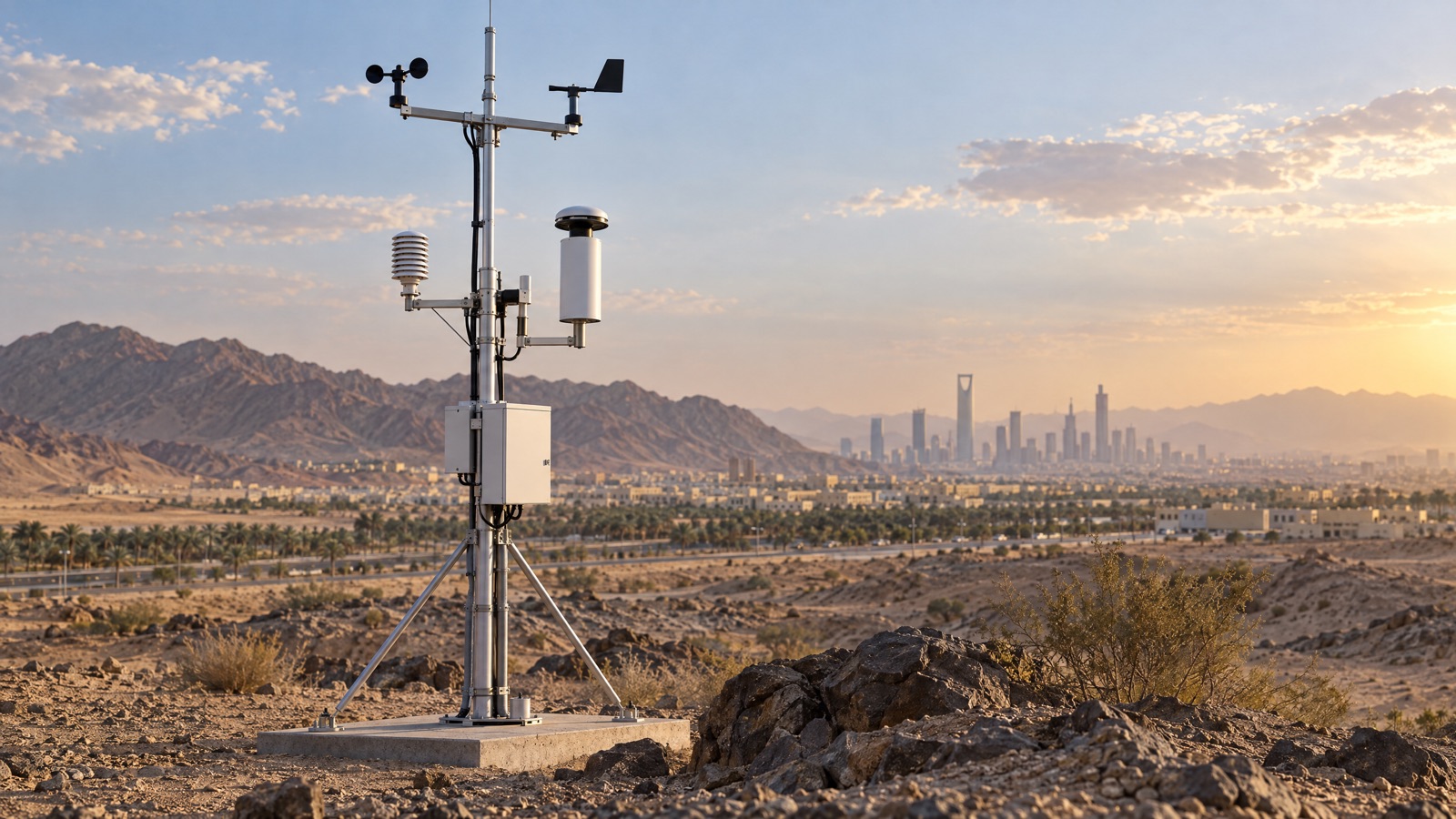
EnviroSaudi supplies meteorological sensors and air quality integration in Saudi Arabia, connecting weather measurements to air-quality monitoring systems for industrial operators, contractors, consultants, municipalities and infrastructure teams. A coordinated system can combine wind speed and direction, temperature, relative humidity, pressure and rainfall with pollutant readings, station health, dashboards and alerts. It is suitable for industrial boundaries in Jubail and Yanbu, construction and urban networks in Riyadh, coastal projects in Jeddah, Dammam and Khobar, and remote monitoring elsewhere in the Kingdom.
You receive a written proposal setting out the configuration, scope, lead time and price. Send the air-monitor models, required weather parameters, site layout, mounting constraints, data interval and reporting objective to contact EnviroSaudi for an integration proposal, or Request a quotation.
Why local weather data improves monitoring operations
Air-quality readings are easier to interpret when they share a reliable time base with local weather observations. Wind speed and direction can show which sector was upwind during an event. Temperature and humidity can explain changing atmospheric or sensor conditions. Pressure and rainfall may add useful operational context, depending on the site and pollutant.
This information does not automatically prove which source caused a reading. A wind shift, obstruction, terrain feature or local building wake can complicate the pattern. EnviroSaudi therefore designs weather integration around an operational question: reviewing a boundary event, comparing stations, supporting a construction response, checking a sensor network or supplying quality-controlled inputs to another responsible specialist.
The scope is equipment and data integration. Equipment supply does not replace the permit, approved method or regulatory decision that applies to your project, and formal regulatory dispersion modelling is a separate service delivered by qualified modelling parties. For a practical explanation of operational use, see why meteorological data matters in air-quality investigations.
Meteorological sensors and air quality integration: parameters and station configuration
A core package may include wind speed, wind direction, air temperature, relative humidity and barometric pressure. Rainfall intensity or accumulation can be added where it helps explain site conditions or supports the owner’s operating workflow. Sensor choice should account for measurement range, accuracy, resolution, response, mounting, power, data interface, environmental exposure and maintenance access.
The weather sensor needs a representative location and suitable mast or structure. Nearby buildings, walls, cranes, stacks and vegetation can distort airflow or shade and heat the instrument. The site survey should also consider lightning protection, grounding, cable routing, safe access and separation from pollutant inlets where the mounting arrangement could affect sampling.
EnviroSaudi coordinates the weather station with a new network through monitoring network design and instrument siting or adds it to selected existing monitors after interface and data compatibility are confirmed.
Scentroid Compact Weather Station option
The Scentroid Compact Weather Station is one accessory for compatible Scentroid monitoring equipment. The current manufacturer page lists temperature, relative humidity, pressure, wind and precipitation. It specifies ultrasonic wind sensing, an electronic compass and an optical precipitation method, and states compatibility with CTmini, CTair and US20.
Published ranges include wind speed from 0.01 to 60 m/s, wind direction from 0 to 359 degrees, temperature from -40 to 70°C, humidity from 0 to 100% RH and pressure from 300 to 1100 hPa, with a listed 1 Hz sample rate. These figures are manufacturer specifications and must be checked against the current submittal for the exact proposed version.
The public product page reviewed for this scope does not state a specific IP or NEMA environmental rating or a detailed field-bus interface for the weather station. EnviroSaudi confirms both from current manufacturer documentation, which the quotation includes for the electrical/data interface, cable length, connector, power, ingress protection, corrosion suitability and mounting arrangement before approval. Configuration, availability and lead time are confirmed in each quotation.
[Image placeholder]
Data alignment, dashboard and alerts
Weather and pollutant data should use consistent station IDs, units, time zones and clock synchronisation. The integration design defines sample and reporting intervals, missing-data flags, quality checks and how values are joined in dashboards or exported reports. Wind values may also require conventions for direction, calm conditions and averaging to be documented so different users read the same chart consistently.
The environmental data dashboards, alerts and BMS interfaces service can combine weather and air-quality trends, equipment status and approved notifications. Alerts should reflect the project’s operating purpose; for example, a particulate alert may include current wind sector as context, while the responsible operator decides the field response. Weather data passed to a third-party platform uses a verified protocol or export method.
Saudi deliverables and lifecycle planning
Riyadh and inland projects may need equipment selected for heat, dust and large daily temperature changes. Coastal sites around Jeddah and the Eastern Province may need explicit corrosion and humidity review. Industrial facilities in Jubail or Yanbu may require owner-standard masts, networks and access procedures.
Deliverables can include:
- parameter schedule and weather-sensor submittal;
- siting and mounting detail;
- air-monitor compatibility matrix;
- wiring and communications diagram;
- time-alignment rules and dashboard brief;
- commissioning checklist, maintenance plan and operator handover.
Frequently asked questions
Who supplies meteorological sensors for air-quality monitoring in Saudi Arabia?
EnviroSaudi supplies and integrates meteorological sensors with air monitors, communications, dashboards and reporting workflows for industrial, construction and urban applications across Saudi Arabia.
How do I choose weather parameters and sensors for air-quality integration?
Wind speed, wind direction, temperature, humidity and pressure are common, and rainfall may also be useful; the final selection follows the pollutant, site conditions and operational decision. Scentroid’s current product page states that the Compact Weather Station is compatible with CTmini, CTair and US20, and EnviroSaudi confirms the exact model version, interface, firmware and installation arrangement before supply.
Can weather and pollutant data appear on the same dashboard?
Yes, when the devices and platform support a verified data path. The configuration aligns time stamps, units, station IDs, reporting intervals and quality flags before combined trends or alerts are commissioned.
What affects the cost of weather sensor integration?
Cost follows the parameters and sensor class, mast and mounting arrangement, power and communications, compatibility with existing monitors, and dashboard or export requirements. The quotation sets these out.
How long does weather sensor integration take?
Timing depends on the sensor configuration, compatibility confirmation with the air monitors, site mounting readiness and dashboard scope. Lead time is confirmed in each quotation.
What information is needed for a meteorological integration quotation?
Provide the site plan, air-monitor models, required weather parameters, mast and power availability, communications system, sample interval, environmental conditions, dashboard or export needs and installation responsibilities.
EnviroSaudi serves projects across Saudi Arabia, including Dammam, Al Khobar, Jubail, Riyadh, Jeddah, NEOM and Qiddiya.
Need meteorological sensors and air quality integration in Saudi Arabia? Request a quotation and EnviroSaudi will set out the configuration, scope and lead time for your site.