
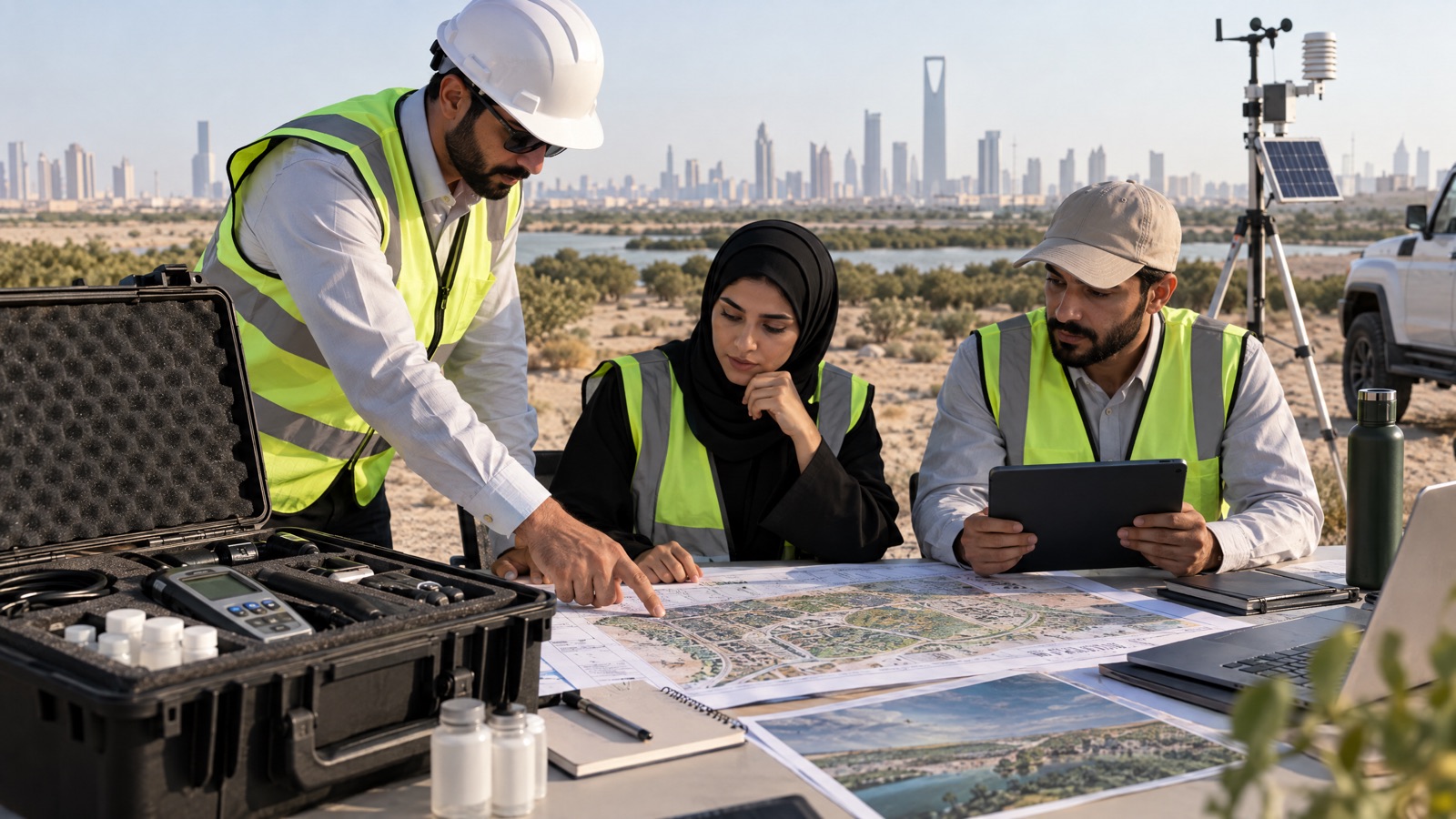
EnviroSaudi provides monitoring needs assessment and air monitoring equipment selection in Saudi Arabia for industrial operators, contractors, consultants, developers and public-infrastructure teams. The service converts a practical question—what must be measured, where, how quickly and for what decision—into a parameter schedule, performance requirements, equipment class and procurement-ready shortlist.
You receive a written proposal setting out the configuration, scope, lead time and price. Send the site layout, sources and receptors, target pollutants, expected ranges, operating conditions, data use and project specification to EnviroSaudi at / for an assessment scope, or Request a quotation.
Start with the buyer’s decision, not a preferred instrument
A monitor that is suitable for short portable checks may be unsuitable for unattended boundary operation. A compact sensor node may add spatial coverage but not meet the same use as a higher-assurance analyser. A PM instrument does not answer a gas-specific question, and a general VOC indicator does not automatically identify individual compounds. The assessment records the decision the data must support before comparing equipment.
The first workstream defines sources, pathways and relevant locations; pollutants and expected minimum, normal and peak ranges; required response and averaging; measurement duration; environmental and installation conditions; and how operators will use trends, alerts or reports. This is procurement-focused selection: equipment selection does not replace the EIA scoping, regulatory baseline study or compliance determination that applies to your project.
Match parameters, ranges and instrument class
The parameter matrix can cover PM1, PM2.5, PM10 or TSP; gases such as NO2, SO2, CO, O3, H2S or NH3; VOC indicators; CO2 and indoor-air parameters; stack measurements; and weather data where relevant. For each parameter, EnviroSaudi records the required range, resolution or detection need, sampling interval, known interference concerns, inlet or sample-path needs, operating temperature and humidity, mounting, power and communications.
The US EPA’s Air Sensor Toolbox explains that lower-cost and portable sensors are widely used but are generally distinct from regulatory-grade monitors. It provides resources for study design, performance evaluation, collocation and data interpretation. Accordingly, the selection report identifies the proposed data use and any need for reference comparison, because monitors are not equivalent to one another.
Air monitoring equipment selection: compare real configurations
For portable multi-parameter screening, the Scentroid TR8+ manufacturer page lists up to 10 sensors, an adjustable sampling rate, GPS, temperature and humidity logging, a built-in pump, battery operation and Bluetooth connection to an Android device. For fixed compact networks, the Scentroid CTair page lists up to 11 sensors, one-minute sampling, wall or pole mounting and several remote communications options.
For a pumped modular station, the Aeroqual AQS 1 page lists particulate fractions and configurable gas modules with remote real-time data. These are three different products. The assessment compares:
- portability and unattended operation;
- parameter and range availability;
- sample management and communications;
- power, enclosure and maintenance;
- required data quality.
Where the need is already clear, buyers can move to mobile and portable air-monitoring equipment, ambient air-quality monitoring networks or dust and particulate monitoring systems. The assessment prevents a premature product choice when several routes remain plausible. Configuration, availability and lead time are confirmed in each quotation.
Selection report and procurement handover
The deliverable can include:
- measurement-objective statement and source and location summary;
- parameter and range matrix and equipment-class comparison;
- shortlisted models, option and accessory schedule;
- power and communications requirements, dashboard or export needs;
- installation constraints and calibration and maintenance considerations;
- questions requiring customer or authority confirmation.
The report then feeds equipment supply, configuration and factory coordination with a controlled bill of materials. Where a multi-station system is selected, network design and instrument siting develops the operational layout. This handover reduces substitutions that alter the required measurement or interface.
Saudi application conditions
Equipment selection is available for projects across Saudi Arabia, including Riyadh, Jeddah, Jubail and Yanbu. Riyadh construction and logistics projects may require heat, dust, remote power and relocatable mounting. Jeddah ports and mixed-use areas may add humidity and coastal exposure. Jubail and Yanbu industrial facilities may need selected gas, particle and weather measurements around complex sources. Mining and cement sites may require robust inlets and frequent inspection, while building applications need room-level parameters and appropriate interfaces.
Frequently asked questions
Who provides air monitoring equipment selection in Saudi Arabia?
EnviroSaudi provides procurement-focused assessments that define pollutants, ranges, locations, data requirements, equipment classes and a shortlist for Saudi industrial, infrastructure, construction and building projects, including industrial boundaries, mines, cement plants, ports, utilities, urban networks and stack-monitoring projects.
What does air monitoring equipment selection include?
The scope can include source and receptor review, parameter and range definition, deployment conditions, equipment comparison, communications, data outputs, installation constraints, calibration needs and a procurement handover. The comparison can include portable analysers such as Scentroid TR8+, compact fixed platforms such as CTair, modular stations such as Aeroqual AQS 1, dedicated PM monitors, weather sensors and relevant data accessories.
How do you choose between portable and fixed equipment?
Portable equipment suits route surveys, troubleshooting and spot or short-duration measurements. Fixed equipment suits unattended trending, boundary locations and connected networks. Required duration, coverage, power, communications and data quality guide the choice.
Is this a regulatory baseline study or compliance determination?
No, it is an equipment-procurement service. The applicable project or authority requirements are supplied or confirmed separately, and EnviroSaudi selects equipment against that defined basis.
What affects the cost of an equipment-selection assessment?
Cost follows the number of sites and locations, the parameter list, the depth of equipment comparison and the shortlist and documentation required. The quotation sets these out.
How long does an assessment take?
Timing depends on the number of sites, availability of source and layout information and the number of parameters to compare. Delivery time is confirmed in each quotation.
EnviroSaudi serves projects across Saudi Arabia, including Dammam, Al Khobar, Jubail, Riyadh, Jeddah, NEOM and Qiddiya.
Need air monitoring equipment selection in Saudi Arabia? Request a quotation and EnviroSaudi will set out the scope and lead time for your assessment.