
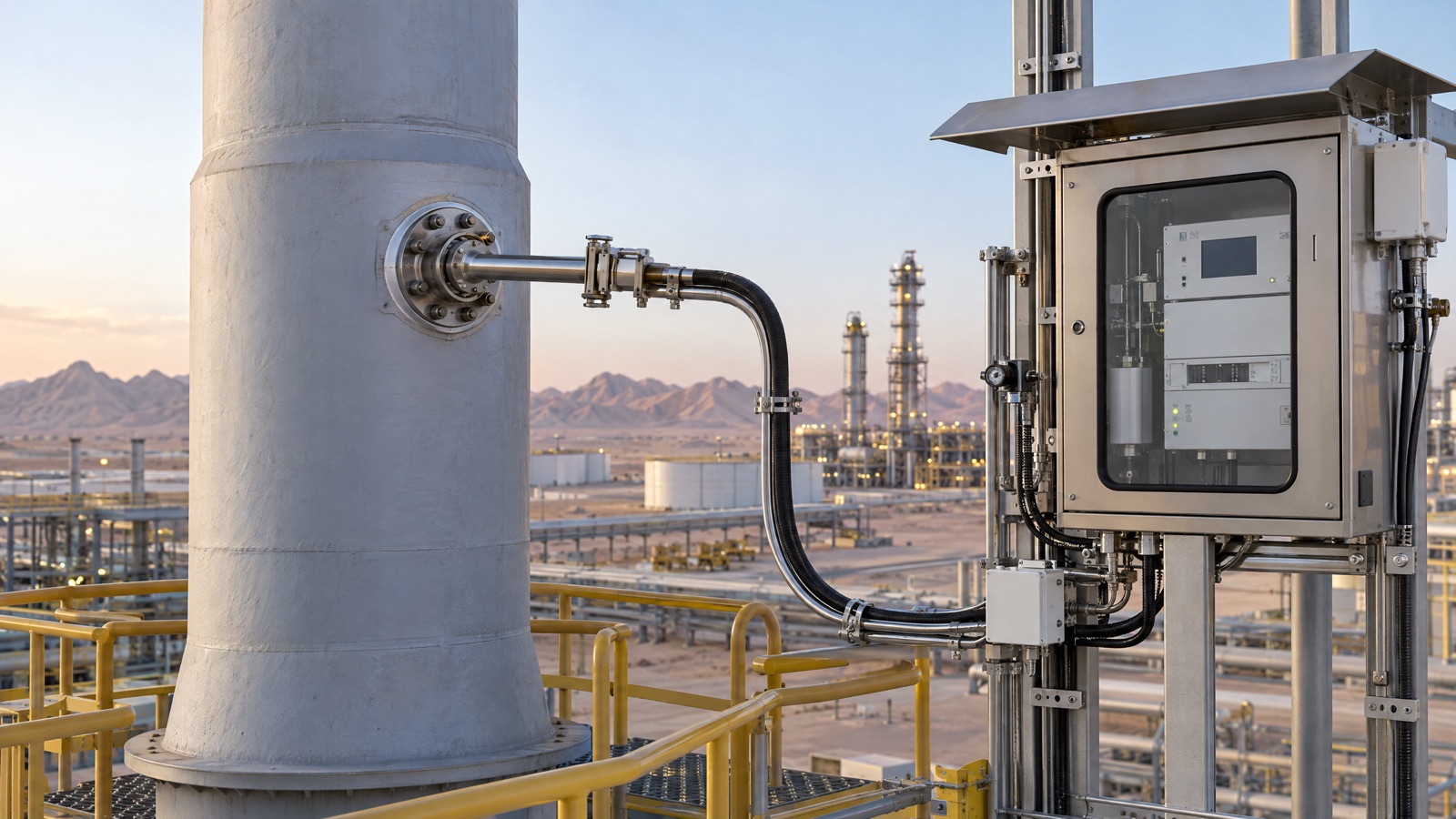
EnviroSaudi supplies continuous emissions monitoring systems (CEMS) and integration scopes in Saudi Arabia for power, utility, petrochemical, cement, manufacturing and other process facilities. We convert a stack, pollutant and reporting requirement into a defined measurement chain: sampling interface, sample transport and conditioning where required, analysers, calibration functions, data acquisition, plant-system interfaces and maintenance planning.
You receive a written proposal setting out the configuration, scope, lead time and price. Send the stack data, fuel and process information, target components, expected ranges, applicable specification and DCS or historian requirements to EnviroSaudi at / for a technical and commercial proposal, or Request a quotation.
Define the measurement duty before selecting analysers
A CEMS cannot be selected from pollutant names alone. The design basis should identify whether results are required as concentration, corrected concentration or emission rate; the required averaging period; normal, startup and shutdown conditions; stack temperature, pressure, moisture and dust loading; sample composition; and the oxygen, flow, moisture or other supporting measurements needed for calculations.
The US EPA defines a CEMS as the total equipment necessary to determine a gas or particulate concentration or emission rate using analyser measurements and a conversion equation, graph or computer program. Its continuous emission monitoring guidance also distinguishes the installed system from the performance specifications and QA procedures used under particular rules. That distinction is useful for procurement in Saudi Arabia: buying an analyser is not the same as delivering a complete measurement system, and US EPA material does not itself establish Saudi approval.
Continuous emissions monitoring systems we supply: components and sample path
An extractive system commonly begins with a probe and filter at the stack. A heated line, pump and conditioning arrangement then transports and prepares the sample before it reaches the analyser rack. The exact path depends on whether the measurement remains hot and wet, is conditioned to a dry basis, or uses dilution or another approved architecture. Condensation, reactive-gas losses, particulate loading, line length and ambient conditions must be considered before fixing the design.
The analyser package may measure SO2, NO or NOx, CO, CO2, O2, total hydrocarbons, moisture, particulate matter or another specified component. Supporting instruments may measure stack flow, pressure and temperature. A calibration manifold, zero and span gases, valves, regulators and safe venting are part of the system where the selected method requires them. The proposal also identifies shelter or cabinet conditions, HVAC, electrical supply, hazardous-area requirements, access and consumables.
One current family that can be evaluated for a suitable dilution-CEMS architecture is the Teledyne API T Series. Teledyne API identifies the T200 as a chemiluminescence NO/NO2/NOx analyser for ambient or dilution-CEMS monitoring. The manufacturer separately identifies the T100 as a UV-fluorescence SO2 analyser and the T300 as a gas-filter-correlation CO analyser. These model relationships do not establish suitability for a hot-wet system, PM, O2, moisture or every stack condition; the approved method, range, sample conditioning and complete architecture must be verified. EnviroSaudi supplies these brands per project; see Teledyne API analysers and ENVEA air and emissions products. Configuration, availability and lead time are confirmed in each quotation.
[Image placeholder]
Data acquisition and plant integration
The data acquisition and handling layer receives analyser and supporting-instrument signals, applies agreed calculations, records calibration and fault states, and produces operator views and exports. Integration planning defines:
- analogue or digital interfaces, point names and units;
- time synchronisation and averaging;
- data-validity rules and substitution rules if permitted;
- alarms, audit records and the destination for reports.
The CEMS package can exchange information with a plant DCS, PLC, historian or reporting platform, but the interface boundary must be explicit. EnviroSaudi prepares the I/O schedule, communications requirements, network diagram and functional checks. The plant controls and cybersecurity teams retain responsibility for system access, logic, interlocks and site network acceptance. For the physical delivery workstream, see installation and commissioning coordination; for ongoing requirements, see calibration, maintenance and spare-parts planning.
Performance checks, QA and handover
Equipment selection should trace every required measurement to a range, method, performance criterion and QA activity. The EPA’s official CEMS performance-specifications index lists separate specifications for pollutants and measurements including SO2/NOx, O2/CO2, CO, flow, H2S, VOC, particulate matter and extractive FTIR. Its QA procedures page explains that QA procedures evaluate the effectiveness of QC/QA and the quality of continuous data in the rules where they apply.
For a Saudi facility, equipment supply does not replace the permit, approved method or regulatory decision that applies to your project; the project team identifies the actual Saudi permit, regulation, approved method and authority requirements. Handover includes:
- equipment data sheets and sample-system drawings;
- I/O and tag lists and configuration records;
- calibration plan and preventive-maintenance schedule;
- spare and consumable list;
- commissioning records and operator training requirements.
Saudi industrial applications
CEMS projects are available across Saudi Arabia, including Jubail, Yanbu and the Eastern Province. Jubail and Yanbu petrochemical or utility facilities may require careful coordination with existing analysers, shelters, DCS standards and shutdown windows. Cement and mineral-processing sites may place greater emphasis on particulate loading and sample-path maintenance. Power and desalination facilities in the Eastern Province or western coast may need multiple stacks and common data handling. Remote industrial sites require realistic plans for gases, filters, spares, communications and technician access.
Frequently asked questions
Who provides continuous emissions monitoring systems in Saudi Arabia?
EnviroSaudi supplies CEMS equipment and prepares sample-system, data-acquisition and plant-interface scopes for Saudi industrial facilities. The proposal can include selection, supply, configuration, installation coordination, commissioning checks, documentation and maintenance planning.
What is included in a continuous emissions monitoring system package?
Depending on the method, a package can include a probe and filter, heated or conditioned sample path, pump, gas or particulate analysers, supporting flow or oxygen measurements, calibration-gas hardware, shelter or cabinet, data acquisition and plant interfaces.
Which industrial applications and pollutants can use a CEMS?
Power generation, cement, refining, petrochemical, metals and other combustion or process facilities may require continuous stack measurements. Common duties include SO2, NOx, CO, CO2, O2, total hydrocarbons and particulate matter, with flow, pressure, temperature or moisture used where required. The applicable requirement and stack conditions determine the exact measurement list and technology.
Can EnviroSaudi connect a CEMS to an existing DCS or historian?
The integration scope defines signals, tags, units, communications, alarms, status flags, time synchronisation and acceptance checks. The plant owner or controls contractor retains responsibility for DCS logic, cybersecurity and final network approval.
What affects the cost of a CEMS?
Cost follows the number of stacks, the components and ranges measured, the sample-conditioning architecture, shelter and utilities, data-acquisition and DCS interface scope, and the installation and maintenance requirements. The quotation sets these out.
How long does CEMS delivery take?
Timing depends on the analyser package and sample-system design, shelter and utilities, plant interface scope, site access and shutdown windows. Lead time is confirmed in each quotation.
What information is required for a CEMS proposal?
Provide stack and process data, fuel, target components and ranges, moisture and dust conditions, applicable specification, required calculations and averaging, existing equipment, utilities, hazardous-area details, DCS or historian interfaces, access and programme.
EnviroSaudi serves projects across Saudi Arabia, including Dammam, Al Khobar, Jubail, Riyadh, Jeddah, NEOM and Qiddiya.
Need a continuous emissions monitoring system in Saudi Arabia? Request a quotation and EnviroSaudi will set out the configuration, scope and lead time for your stacks.