
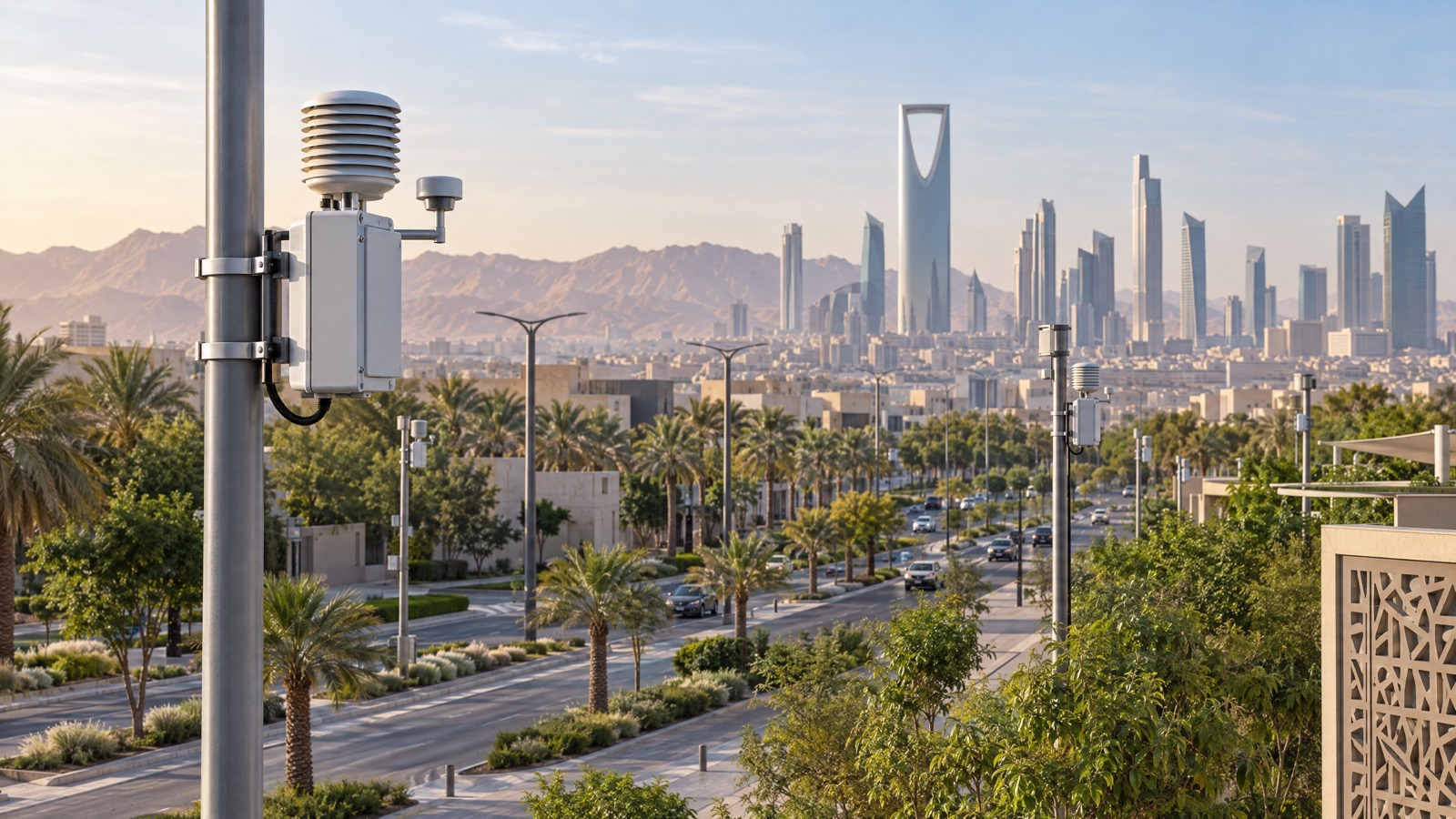
EnviroSaudi supplies municipal air monitoring network equipment in Saudi Arabia, helping municipalities, development authorities, urban operators and technology integrators prepare procurement-ready networks. The scope combines compact sensor nodes, selected higher-assurance stations, weather inputs, communications and a public or operational dashboard. We focus on the equipment, data path, acceptance checks and maintenance model needed to keep a city network usable after launch.
You receive a written proposal setting out the station classes, scope, lead time and price. Request a quotation
This industry page is for buyers deciding what to procure and how to govern delivery. The related smart-city and urban air-monitoring solution explains the general solution architecture, while ambient network planning addresses broader station and pollutant design. An urban sensor node is not equivalent to a reference station, and each tier is described accurately in the proposal.
Define the municipal outcome first
Network design changes with the intended outcome. A city may want neighbourhood-level particulate trends, corridor comparisons, construction-area visibility, school or park context, event monitoring, or an operating display for environmental teams. The specification should state which questions the network can answer and which it cannot.
EnviroSaudi turns that purpose into a requirements matrix covering pollutants, performance class, station density, siting categories, sampling and averaging, weather measurements, uptime targets supplied by the buyer, communications, data retention, dashboard audiences and maintenance responsibilities. A pilot phase tests installation, connectivity, field behaviour and operating effort before wider rollout. It is a procurement risk-control step; a short pilot does not validate every season or establish regulatory equivalence.
Municipal air monitoring network in Saudi Arabia: a tiered equipment strategy
A scalable urban network does not need every site to use identical equipment. Compact nodes improve spatial coverage where their sensors and operating conditions suit the intended use. A smaller number of modular or higher-assurance stations support comparison, continuity and more demanding data needs. Portable equipment helps investigate a location before committing to permanent infrastructure.
The Scentroid CTair manufacturer page describes a compact platform with selectable gas and particulate sensor technologies, local storage and several communications options. The Aeroqual AQS 1 is a pumped modular station that measures particulate matter plus up to four selected gases simultaneously, with environmental measurement options. These are examples of different station classes; exact modules, ranges, combinations and suitability are confirmed in the quotation.
The US EPA Air Sensor Toolbox distinguishes sensor applications from regulatory monitoring and emphasises performance evaluation. Its collocation guide explains how operating sensors alongside a reference monitor under real-world conditions helps evaluate performance. The applicable Saudi programme requirements determine the comparison method and acceptance criteria.
Specify siting, communications and the data product
EnviroSaudi is available for projects across Saudi Arabia, including Riyadh traffic corridors, Jeddah coastal districts, Dammam and Khobar urban-industrial interfaces, Makkah high-occupancy areas and new developments. These locations present different pollutants, microclimates, access constraints and communications conditions. Site categories are defined before individual poles or rooftops are chosen.
Each location record includes:
- the monitoring purpose and surrounding sources;
- obstruction clearance and inlet height;
- security, access and power;
- communications signal and maintenance route.
The data specification defines station and sensor identifiers, units, timestamps, quality and status flags, calibration records, audit trail, user roles, exports and application-programming interfaces where verified. A public display may use simplified indices or messages, while technical users need the underlying measurements and device-health information. The responsible authority approves any public communication logic.
Plan acceptance and operations before rollout
Municipal procurement includes more than instrument datasheets. EnviroSaudi prepares a bill of materials, station class schedule, siting criteria, connectivity plan, installation boundary, factory and site checks, collocation or comparison requirements where specified, dashboard acceptance cases, documentation list, training plan, consumables and spare-parts schedule.
Ongoing governance names who reviews device health, investigates missing data, cleans inlets, handles field swaps, approves firmware or configuration changes and communicates system outages. Calibration, maintenance and spare-parts planning defines these routines around the selected equipment. Uptime, response time and coverage are set out in a confirmed design and service agreement. Configuration, availability and lead time are confirmed in each quotation.
Prepare a municipal network enquiry
Provide the city or development area, decision objectives, target pollutants, desired station classes and approximate coverage, priority site categories, existing assets, power and communications options, data users, public-display expectations, cybersecurity requirements, procurement stage and delivery programme. EnviroSaudi proposes a phased equipment and integration scope with clear acceptance criteria and responsibility boundaries. Carbon planning, public-sector sustainability strategy and formal environmental studies are separate assignments.
Frequently asked questions
Who provides municipal air monitoring networks in Saudi Arabia?
EnviroSaudi helps define procurement requirements, selects station classes, plans siting categories, configures equipment, coordinates installation, connects data, supports acceptance checks and prepares training, maintenance and spare-parts requirements.
How do I choose equipment for a municipal air monitoring network?
Options include compact multiparameter sensor nodes, pumped modular stations, dedicated particulate instruments, weather sensors, communications gateways and portable monitors. The final mix depends on the pollutant, data purpose, coverage, climate and maintenance model.
Are compact sensor nodes the same as reference stations?
No. They differ in measurement principle, performance, operating requirements and intended use. A network can use multiple equipment tiers, evaluated through documented field comparison or collocation against the programme's data objectives, with duration, seasonality and acceptance criteria approved for each programme.
Can urban monitoring data feed a public dashboard?
Yes, if the data pipeline, validation status, messaging rules, user roles and interfaces are defined. The authority approves indices, health messages and publication rules; raw sensor readings should not be presented without context.
Can the network expand after a pilot?
Yes. A phased architecture preserves naming, interfaces, station templates and operating procedures while adding sites. Expansion follows pilot evidence, updated siting needs, communications testing, budget approval and a realistic maintenance capacity.
What affects the cost of a municipal air monitoring network?
Cost depends on the number of stations in each class, pollutants and sensors, weather inputs, communications, dashboard scope, installation and maintenance model, and site locations.
How long does a municipal air monitoring network take to deliver?
Timing depends on the network size, station classes, supplier lead time, siting approvals, installation scope and any pilot phase. Lead time is confirmed in your quotation.
EnviroSaudi serves projects across Saudi Arabia, including Dammam, Al Khobar, Jubail, Riyadh, Jeddah, NEOM and Qiddiya.
Request a quotation
Send us your city or development area and objectives and we will set out the scope, lead time and price for a municipal air monitoring network in Saudi Arabia in a written proposal. Request a quotation