
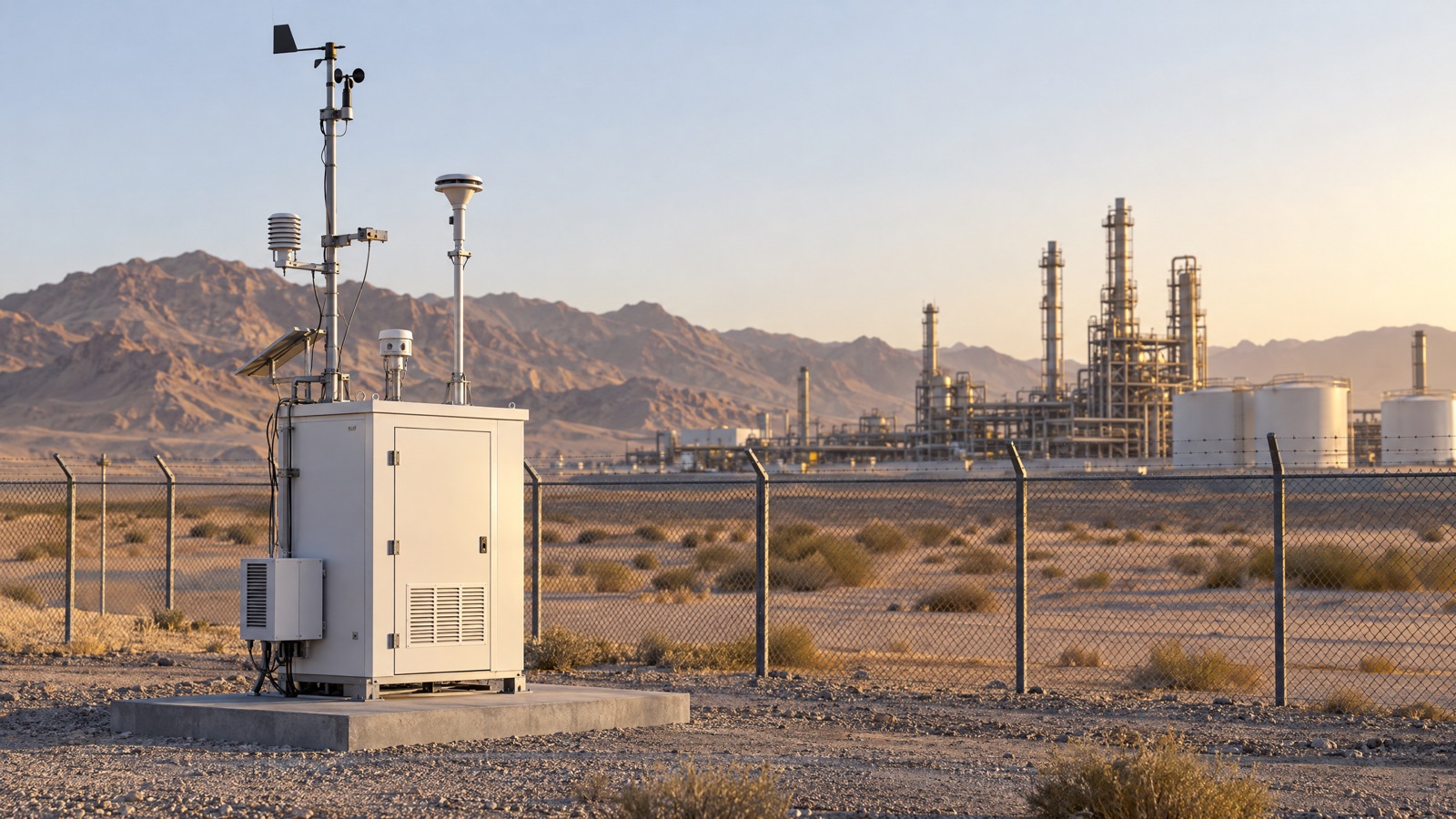
EnviroSaudi designs, supplies and configures industrial fenceline air monitoring systems in Saudi Arabia for plants, terminals, utilities, waste facilities, bulk-handling sites and industrial zones. A system can combine fixed gas and particulate monitors, weather sensors, communications, dashboards, event alerts and operating procedures around a site boundary. We translate the source areas, target pollutants, nearby receptors and decision thresholds into a location plan and equipment schedule.
You receive a written proposal setting out the configuration, scope, lead time and price. Send the site layout, process and storage areas, target compounds, prevailing-wind information and required data outputs to EnviroSaudi or Request a quotation.
Define what the fenceline system must detect
“Fenceline monitoring” can describe different measurement duties. One operator may need real-time indication of a sudden gas or particle change. Another may need time-integrated sampling for a specified compound. A bulk terminal may focus on dust movement during handling, while a refinery or chemical site may prioritise selected gases, VOC indicators and wind direction. These are not interchangeable scopes.
The design basis should list the sources, expected release patterns, concentration range, relevant receptors, required time resolution and intended response. It should also state whether the result is for operational awareness, investigation support or a formally specified monitoring programme. EnviroSaudi is responsible for the equipment and network-integration scope. Equipment supply does not replace the permit, approved method or regulatory decision that applies to your project, and odour-complaint investigations and formal dispersion studies are separate services from a boundary-monitor purchase.
Locations, pollutants and station architecture
Station locations are developed from source geometry, wind patterns, property boundaries, terrain, buildings, access, power, communications and receptor direction. A single downwind point cannot represent every wind condition. Depending on the objective, the network may include upwind or context locations, several boundary points and a weather station. The related monitoring network design and instrument siting service can document these practical constraints, while meteorological and air-quality integration covers the weather-data layer.
Measurement options can include PM1, PM2.5, PM10 or TSP; selected gases such as H2S, SO2, NO2, CO or NH3; and VOC indicators where the sensor and expected mixture make that measurement useful. Compound-specific monitoring may require a different method from a general VOC indicator. The US EPA publishes Method 325A for sampler deployment and VOC sample collection and Method 325B for preparation and analysis. These methods illustrate a time-integrated sampling route; they should not be confused with a continuous electronic sensor or treated as a Saudi requirement unless the project specifies them.
[Image placeholder]
Industrial fenceline air monitoring systems we supply: monitors, weather data and alerts
For a modular fixed station, the Aeroqual AQS 1 manufacturer page lists simultaneous PM1, PM2.5, PM4, PM10 and TSP measurement. It can be configured to measure particulate matter plus up to four gases at the same time, selected from manufacturer-listed options including VOCs, ozone, NO2, CO, H2S, SO2, methane and benzene. Environmental-sensor options are also available. This four-gas limit is important when translating a long pollutant list into an actual station schedule.
The Scentroid CTair page lists up to 11 sensors across PID, NDIR, electrochemical, laser-particle and metal-oxide technologies, one-minute sampling, and Wi-Fi, 3G/4G, LoRa and Modbus TCP/IP communications. Its stated maximum includes defined sensor positions and environmental channels rather than 11 unrestricted gas choices. Manufacturer lists are starting points: target range, gas mixture, cross-sensitivity, humidity, temperature, inlet design, power and local validation still affect suitability. Configuration, availability and lead time are confirmed in each quotation.
Weather data gives an event operational context. Wind direction can help identify which source or receptor lies upwind or downwind at the time of a peak, while wind speed, temperature and humidity can support interpretation. It does not by itself prove source attribution. The dashboard can combine trends, wind data, operating events and status flags, with alerts routed to agreed users. The response plan defines persistence, verification and escalation steps before an automated alert becomes an operational conclusion.
Delivery, QA and Saudi operating conditions
An EnviroSaudi fenceline package can include:
- design basis and station-location schedule;
- parameter and range matrix, selected models and bill of materials;
- mounting and power requirements, communications architecture;
- dashboard and alarm brief;
- installation notes, commissioning checklist, maintenance plan and handover records.
QA activities may include configuration control, inlet and flow checks, zero or span checks where applicable, collocation or comparison, data-status review and documented maintenance.
The equipment schedule should also identify consumables, calibration accessories, communications subscriptions, cleaning access and the party responsible for each recurring task. These details affect data availability and operating cost after commissioning. Where a hazardous-area classification applies, the proposed enclosure, power arrangement and installation method require project-specific review rather than an assumption based on the sensor name alone.
Fenceline projects are available across Saudi Arabia, including Jubail, Yanbu, Dammam, Jeddah and Riyadh. Jubail and Yanbu petrochemical sites may require coordination across tanks, process units, loading areas and shared industrial boundaries. Dammam and Jeddah logistics or port facilities may combine dust, vehicle activity and coastal conditions. Riyadh manufacturing and waste sites may prioritise heat, dust, power resilience and remote access. Mining, quarry and cement applications require equipment suited to heavy particulate loading and realistic cleaning intervals.
The proposal identifies civil works, safe access, hazardous-area review, power, SIM/data services and operator responsibilities. Detection range and response time depend on pollutant behaviour, station spacing, wind, terrain and instrument capability, so each is set per project.
Frequently asked questions
Who provides industrial fenceline air monitoring systems in Saudi Arabia?
EnviroSaudi supplies and configures fixed boundary-monitoring equipment, weather sensors, communications, dashboards and operating documentation for Saudi plants, terminals, utilities and industrial zones.
How do I choose fixed monitors and pollutants for a fenceline system?
Depending on the source and method, a system can measure particulate fractions, selected gases such as H2S, SO2, NO2, CO or NH3, and VOC indicators. The Aeroqual AQS 1 can combine simultaneous particle fractions with up to four selected gases, and the Scentroid CTair is a configurable multisensor option with remote communications and SIMS3 functions. The final model, modules and ranges follow the pollutant list, expected concentrations and site conditions; compound-specific results may require passive sampling or another approved analytical method.
How are fenceline monitoring locations selected?
Locations are selected from source areas, boundary geometry, wind patterns, receptors, obstructions, terrain, access, security, power and communications. Several points may be needed because the downwind direction changes.
Can fenceline data identify the exact source of every event?
Not by itself. Concentration trends, wind and operating records can support investigation, but source attribution may need more locations, portable checks, process evidence, compound-specific analysis or specialist modelling.
What affects the cost of a fenceline monitoring system?
Cost follows the number of boundary locations, the pollutant and range list, weather sensors, communications and power, dashboard and alert requirements, and installation and maintenance scope. The quotation sets these out.
How long does fenceline system delivery take?
Timing depends on the equipment configuration, number of stations, site access, power and communications readiness and hazardous-area review. Lead time is confirmed in each quotation.
What information is needed to design and quote a fenceline system?
Provide the site layout, source and storage areas, target compounds and expected ranges, nearby receptors, available wind data, required time resolution and outputs, utilities, access constraints and responsibility split. EnviroSaudi can then prepare the location, equipment and delivery schedule.
EnviroSaudi serves projects across Saudi Arabia, including Dammam, Al Khobar, Jubail, Riyadh, Jeddah, NEOM and Qiddiya.
Looking for industrial fenceline air monitoring systems in Saudi Arabia? Request a quotation and EnviroSaudi will set out the configuration, scope and lead time for your site.