
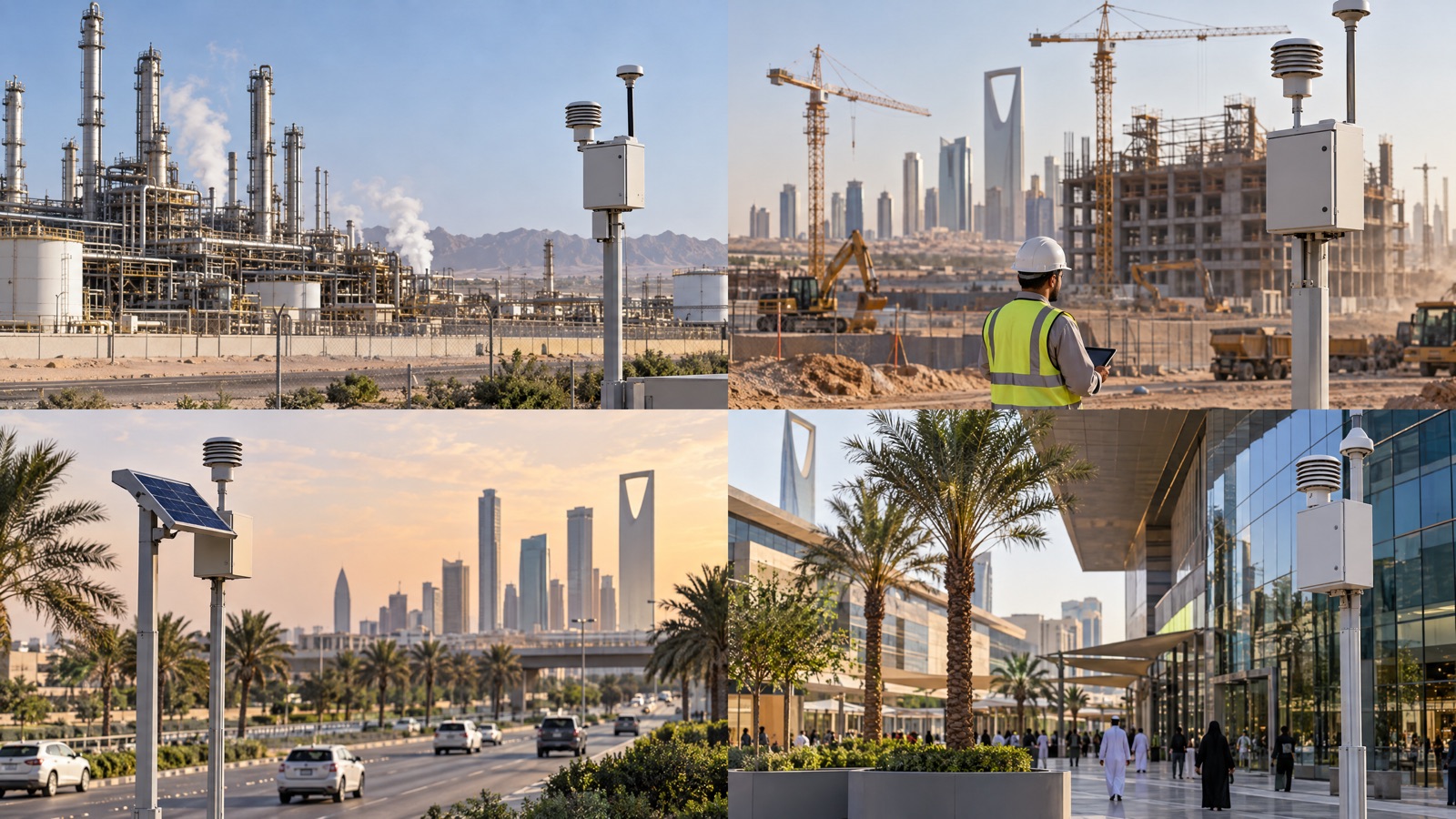
EnviroSaudi supplies air monitoring equipment for industries in Saudi Arabia, including fixed stations, compact sensor nodes, portable instruments, meteorological accessories, dashboards and compatible building interfaces. We serve industrial, construction, infrastructure, municipal and commercial applications, and the right equipment depends on what must be measured, where it operates, how often data is needed and who acts on it.
You receive a written proposal setting out the equipment configuration, scope, lead time and price. Request a quotation
This hub directs buyers to the relevant application page. EnviroSaudi's role is equipment selection, network configuration, supply coordination, installation support, commissioning and lifecycle planning. Formal environmental studies, permit preparation, EIA work and sustainability strategy are separate professional scopes that equipment supply does not replace.
Choose the application before the instrument
A useful brief identifies the decision the data will support. A facility-boundary network may need multi-point trends and wind context. A construction team may need relocatable particulate nodes. A building operator may need room-level carbon dioxide and comfort data in an existing facility platform. An HSE team investigating a changing work area may need a portable screening instrument.
EnviroSaudi turns that need into a monitoring concept covering parameters, sensor technology, siting, enclosure, power, communications, logging, dashboards, maintenance and handover. A monitoring-needs assessment is the starting point when parameters or network scale are unclear.
Air monitoring equipment for industries in Saudi Arabia: industry routes
Oil, gas and petrochemical operations
Facility teams may need fixed gas, particulate and weather data at process-area boundaries, utilities, storage areas or community-facing edges. The oil, gas and petrochemical air-monitoring page explains fixed and portable configurations and the distinction between environmental enclosures and equipment approved for classified hazardous areas.
Construction, infrastructure and major programmes
Earthworks, demolition, crushing, concrete activity and vehicle movements can change dust conditions quickly. The construction, infrastructure and megaproject page covers particulate nodes, weather integration, relocation and reporting across active packages.
Manufacturing and process facilities
Manufacturers may use monitoring networks around boundaries, material handling, utilities, workshops or selected indoor areas. Visit manufacturing and process air monitoring for equipment-led applications distinct from occupational exposure assessment or process-safety studies.
Power, utilities and resource-intensive industries
Power and utility sites may combine source-related monitoring, boundary measurements and weather context. The power and utilities page covers that need. Mining, quarry and cement activities have a separate dust-monitoring route focused on particulate and weather networks.
Cities, ports and logistics areas
Distributed networks help operators compare urban, port or industrial-zone locations. Explore municipal and smart-city air networks or ports, logistics and industrial-zone monitoring according to the owner and operating environment.
Commercial buildings
Indoor networks provide carbon dioxide, particulate, gas and comfort data when selected monitors support the required parameters. The indoor-air-quality and ventilation monitoring solution covers room-level monitoring and interface coordination while controls contractors retain responsibility for ventilation logic and life-safety systems.
Equipment roles within a monitoring programme
Manufacturer specifications help define a starting fit. The Scentroid CTair is a configurable fixed platform with gas and particulate sensor options, local storage and several communications options. The compact CTmini measures particulate fractions and can add selected gas sensors, making it a candidate for denser networks after application review.
For mobile work, the TR8+ combines configurable sensors, a pump, GPS, logging and an Android interface. It supports screening and spatial investigations, but portability does not make it a regulatory reference monitor. Indoor applications may use the HW20, which publishes BACnet and Modbus interface options alongside environmental sensing. Exact sensors, protocols and installation choices are confirmed in each quotation.
Buyers can compare platforms in the air-monitoring products hub and use network design and instrument siting to turn a shortlist into an implementable system.
Saudi deployment factors
Saudi sites introduce heat, airborne dust, coastal humidity, long distances, variable cellular coverage, restricted access and maintenance logistics. EnviroSaudi is available for projects across Saudi Arabia, including Riyadh, Jeddah, Dammam, Jubail, Yanbu and remote locations, and reviews each network for mounting, shielding, power, communications, data buffering and service access.
EnviroSaudi structures the equipment scope and identifies missing technical inputs. Availability, delivery, installation coverage and schedule are confirmed in each quotation.
Start with the operating question
Tell us the industry, Saudi location, layout, parameters, monitoring duration, users, power and communications constraints, required outputs and project specification. EnviroSaudi recommends the next assessment or product-selection step. Contact /.
Frequently asked questions
Who supplies air monitoring equipment for industries in Saudi Arabia?
EnviroSaudi supplies equipment and networks for oil and gas, petrochemical, construction, infrastructure, manufacturing, power, utilities, mining, cement, municipalities, ports, logistics and commercial buildings. Parameters, sensor technology, siting, power, communications and maintenance are selected around your operating question and environment.
When is a fixed monitor more suitable than a portable instrument?
Fixed systems suit time-series data at defined locations. Portable equipment suits screening and changing work areas. Some programmes use both, with portable findings informing fixed-network design.
Are compact sensors equivalent to regulatory reference monitors?
Not automatically. Fitness for a regulatory purpose depends on method requirements, performance evidence, quality controls and the approving authority's criteria.
Can environmental monitors connect to dashboards or building controls?
Compatible devices can feed dashboards, and selected indoor products publish building-protocol options. EnviroSaudi verifies the model and interface; approved controls contractors retain responsibility for logic, interlocks, life safety and final acceptance.
How do I choose air monitoring equipment for my industry?
Send the application, location and layout, parameters, expected range if known, monitoring duration, data users, required outputs, installation constraints and project specification. We recommend the next assessment or product-selection step.
What affects the cost of air monitoring equipment?
Cost depends on the parameters and sensor technology, number of monitoring points, fixed or portable configuration, power and communications, dashboards, installation scope and site location.
How long does air monitoring equipment delivery take?
Timing depends on the selected equipment, configuration, supplier lead time, installation scope and site access. Lead time is confirmed in your quotation.
EnviroSaudi serves projects across Saudi Arabia, including Dammam, Al Khobar, Jubail, Riyadh, Jeddah, NEOM and Qiddiya.
Request a quotation
Tell us your industry and location and we will set out the scope, lead time and price for air monitoring equipment for industries in Saudi Arabia in a written proposal. Request a quotation