
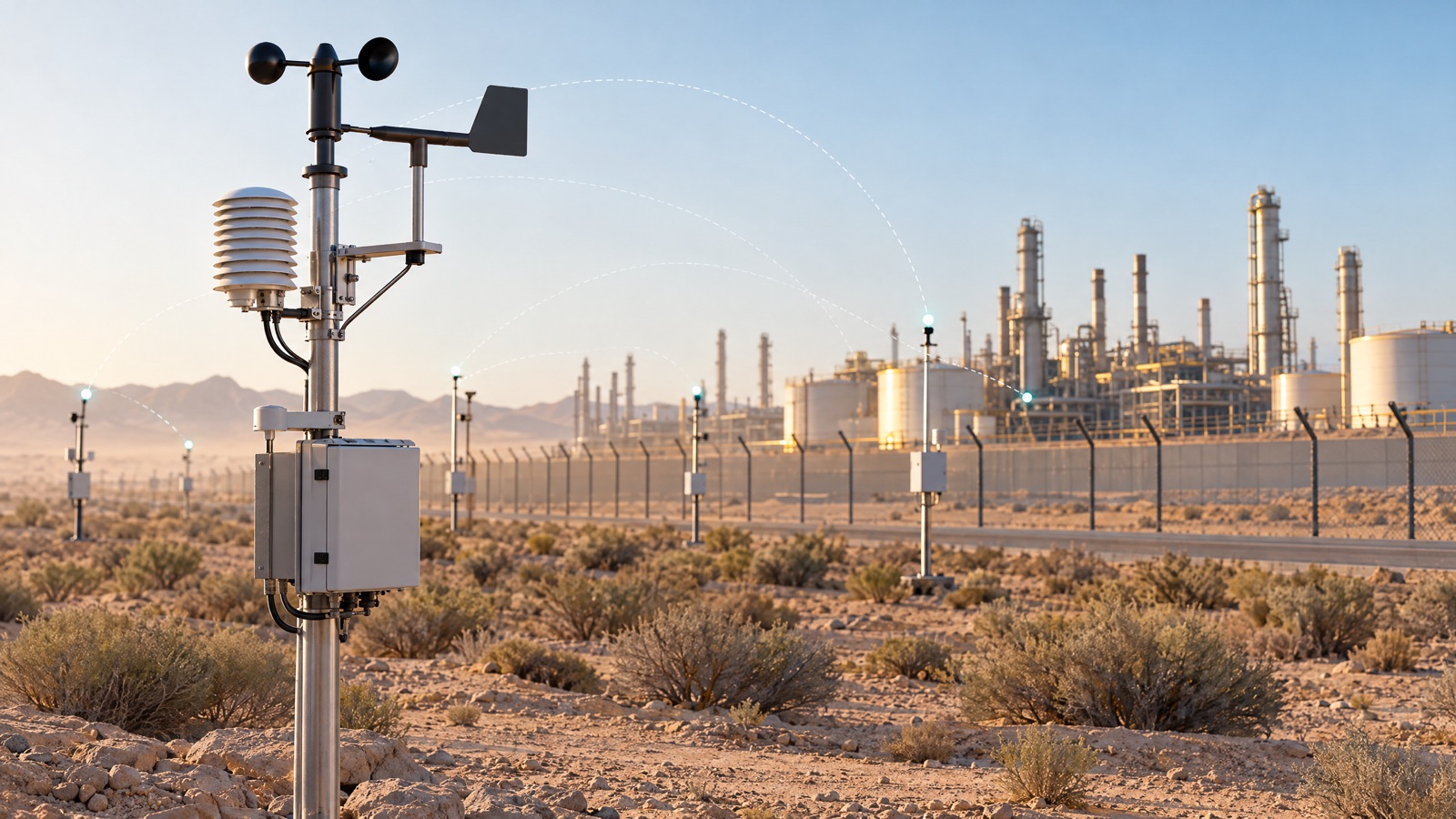
EnviroSaudi provides air monitoring network design and instrument siting in Saudi Arabia for industrial operators, contractors, developers, utilities and municipalities. We turn the monitoring objective into station purposes, proposed locations, equipment classes, mounting arrangements, power and communications, data paths and maintenance access. The service is suitable for ambient, fenceline, dust, construction, urban and meteorological networks.
You receive a written proposal setting out the scope, deliverables, lead time and price. Send the site plan, sources, receptors, prevailing-wind information, target pollutants, available utilities and data requirements to EnviroSaudi at / for a network-design scope, or Request a quotation.
Air monitoring network design: give every station a defined purpose
A useful location answers a specific operational question. An upwind or context station can describe air entering the site. Boundary stations can identify changes around source areas. A downwind or receptor location can show conditions where the project needs visibility. Roadside, work-zone and background positions represent different environments and should not be treated as interchangeable.
EnviroSaudi documents each proposed location with its purpose, target parameters, station class, relevant sources and receptors, and practical constraints. Wind patterns, buildings, terrain, vegetation, roads, safe access, security, inlet clearance and future site changes are considered. This operational layout supports equipment procurement and deployment. It does not replace the regulatory baseline-study design, dispersion model or authority-approved siting decision that applies to your project.
Match station class to network role
A mixed network can be more useful than identical equipment everywhere. Compact nodes can support spatial coverage, dedicated PM stations can focus on dust, modular gas-and-particle stations can serve priority locations, and meteorological sensors can add wind and weather context. The design also states where collocation or comparison is needed.
The US EPA’s Air Sensor Collocation Instruction Guide defines collocation as operating a reference and non-reference monitor at the same time and location under real-world conditions for a defined evaluation period. It explains that this comparison helps users understand sensor accuracy. For Saudi work, the applicable project specification determines the required comparison; the EPA guide is technical planning evidence, not Saudi approval.
For equipment context, the Scentroid CTair manufacturer page lists wall or pole mounting, one-minute sampling, local storage and Wi-Fi, cellular, LoRa and Modbus TCP/IP communications. The Aeroqual AQS 1 page describes a modular pumped station with remote real-time data and options for particle, gas and environmental measurements. The network design confirms the exact model and configuration once the role of each station is fixed. Configuration, availability and lead time are confirmed in each quotation.
Power, communications and data paths
Every station needs a realistic utility plan. The design records mains, solar or battery strategy; load and autonomy assumptions; grounding and surge requirements for the electrical designer; cellular coverage or wired network availability; antenna position; local data buffering; and the route from instrument to dashboard or customer database. It also identifies who provides SIM cards, network addresses, firewall approvals and user access.
The data architecture defines station IDs, parameter names, units, sampling and reporting intervals, time synchronisation, status and fault flags, alarm routing and export requirements. Buyers evaluating a compatible product platform can review the Scentroid SIMS3 environmental data platform, while meteorological sensors and air-quality integration covers weather measurement and correlation. A communications interface carries data; control actions and data validity are confirmed separately.
Installation and maintenance access
Siting must allow safe installation, calibration, cleaning and replacement. The plan records mounting height, foundation or pole needs, inlet clearance, vehicle or technician access, lifting needs, security, shelter or enclosure conditions and likely service frequency. Construction networks may need relocation stages; industrial sites may require permit-to-work and hazardous-area review by the responsible parties; remote sites need a practical spares and visit plan.
The deliverable can include:
- design basis and annotated site plan;
- station-purpose and parameter schedule, proposed equipment classes and collocation points;
- mounting concept, power and communications schedule;
- network diagram and data-path description;
- installation constraints, maintenance-access notes and open decisions.
It then hands over to equipment supply and configuration and installation and commissioning coordination.
Saudi application conditions
Network design is available for projects across Saudi Arabia, including Riyadh, Jeddah, Jubail, Yanbu, Dammam and Khobar. Riyadh construction and urban networks may require dust-resistant installation, heat planning and flexible relocation. Jeddah and western-coast networks may add humidity, corrosion and port influences. Jubail and Yanbu sites may need several source and boundary roles within complex industrial layouts. Dammam and Khobar networks may span industrial, logistics and occupied areas. Large development sites can use repeatable station templates while preserving the distinct purpose of each location.
Frequently asked questions
Who designs air monitoring networks in Saudi Arabia?
EnviroSaudi designs operational monitoring networks with station purposes, locations, equipment classes, power, communications, data paths and maintenance access for Saudi industrial, construction, urban and infrastructure applications, including industrial boundaries, ports, mines, cement sites, utilities, municipalities and large developments.
What does air monitoring network design include?
The scope can include the design basis, annotated location plan, parameter and station schedule, mounting concept, power and communications requirements, network diagram, collocation needs, installation constraints and handover documents. Networks can combine compact nodes such as Scentroid CTair, modular stations such as Aeroqual AQS 1, dedicated particulate monitors, higher-assurance analysers and meteorological sensors, with the station role and data use determining the class.
How are monitor locations selected?
Locations are selected from source and receptor geometry, wind, terrain, obstructions, access, security, utilities, inlet clearance and maintenance needs. Each location is assigned a documented operational purpose.
Does this service include dispersion modelling or regulatory baseline-study approval?
EnviroSaudi designs the operational equipment network. Formal dispersion modelling, baseline-study design and authority approval are separate scopes.
What affects the cost of network design and siting?
Cost follows the number of stations and sites, the station classes, site-survey needs, power and communications arrangements, and the depth of documentation. The quotation sets these out.
How long does network design take?
Timing depends on the number of stations, availability of site plans and source information, and the utilities and data paths to be defined. Lead time is confirmed in each quotation.
EnviroSaudi serves projects across Saudi Arabia, including Dammam, Al Khobar, Jubail, Riyadh, Jeddah, NEOM and Qiddiya.
Need air monitoring network design in Saudi Arabia? Request a quotation and EnviroSaudi will set out the scope and lead time for your network.