
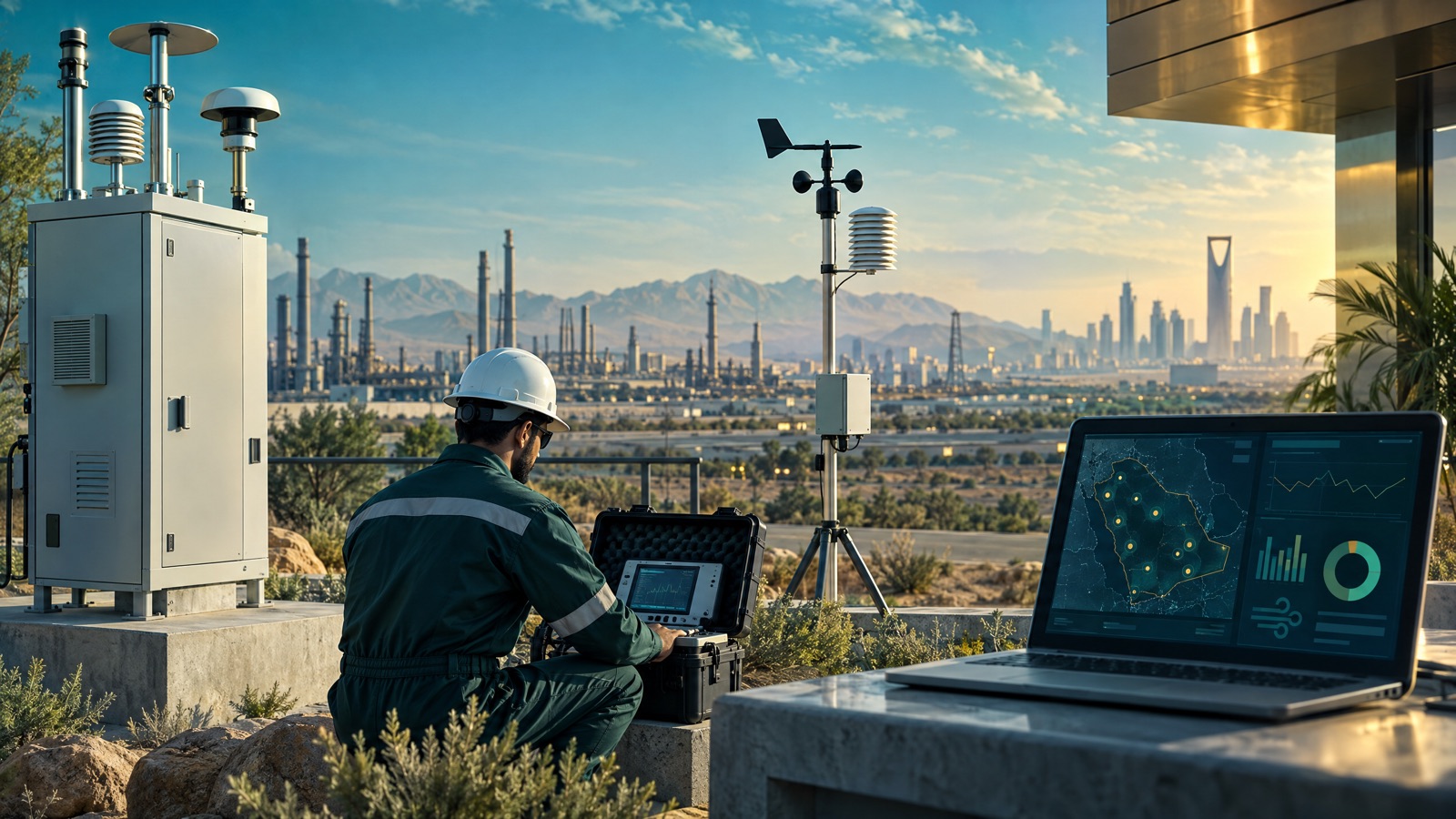
EnviroSaudi supplies and configures air quality and emissions monitoring solutions in Saudi Arabia for industrial operators, utilities, contractors, consultants, developers and facility teams. The scope can cover a single dust monitor, a portable survey instrument, an ambient network, a continuous stack-emissions package or a connected indoor-air system. We turn the monitoring objective into an equipment schedule, station architecture, communications plan, data outputs and lifecycle-support requirements. Send the site type, target pollutants, measurement locations, required reporting interval and project specification to EnviroSaudi at / for a technical and commercial response.
You receive a written proposal setting out the configuration, scope, lead time and price. Request a quotation
Air quality and emissions monitoring solutions in Saudi Arabia: choose the route around the decision
The right system begins with the decision the data must support. A project team may need to see dust moving beyond a work area, compare air conditions around an industrial boundary, track stack concentrations continuously, investigate short events with a portable analyser or trend ventilation indicators inside occupied buildings. These needs require different instruments, sampling arrangements and quality controls.
EnviroSaudi helps buyers separate five practical routes:
- ambient air-quality monitoring networks for several outdoor locations and a common data platform;
- continuous emissions monitoring systems for stack or process-emission measurements;
- dust and particulate monitoring systems for PM and fugitive-dust applications;
- mobile and portable air-monitoring equipment for screening, troubleshooting and route measurements; and
- indoor air quality and ventilation monitoring for buildings, HVAC and selected BMS projects.
The Saudi National Center for Environmental Compliance describes oversight of environmental-media monitoring, including air quality, and the analysis and reporting of environmental data. Its role provides important national context. Equipment supply does not replace the permit, approved method or regulatory decision that applies to your project, so identify those requirements separately through the NCEC environmental-media monitoring page.
Equipment, stations and data architecture
A complete monitoring system is more than a sensor. Depending on the application, the scope can include a sample inlet or probe, gas or particle measurement modules, pumps and conditioning, weather sensors, an enclosure, power supply, data logger, communications, dashboard, alarm routing, calibration equipment and spare-parts planning. The design also records units, averaging periods, time synchronisation, data status flags and how operators will respond to faults or alerts.
Before comparing quotations, the buyer should distinguish measurement from indication. A low-cost node can be useful for trends, hotspot screening and alarms, while a higher-assurance analyser may be needed where the specification demands defined performance, traceability or comparison with a reference method. The proposal should state the intended data use, instrument class, validation plan and any limits on decisions that can be made from the results. This avoids comparing station prices without comparing the evidence each configuration can produce.
For compact outdoor networks, the Scentroid CTair manufacturer page lists configurations with up to 11 sensors, including electrochemical, NDIR, PID and laser-particle technologies. It also publishes PM1, PM2.5 and PM10 measurement, a one-minute sampling rate, wall or pole mounting, 64 GB local storage and Wi-Fi, cellular, LoRa and Modbus TCP/IP communications. These are manufacturer specifications; pollutants, ranges, interferences, enclosure conditions, power and communications are checked against the intended use of each site.
[Image placeholder]
Integration and quality planning from the start
Data quality depends on the complete measurement chain. The US EPA’s Air Sensor Toolbox distinguishes portable, lower-cost sensors from regulatory-grade monitors and recommends performance evaluation, suitable study design and collocation where appropriate. For continuous emissions, the EPA defines a CEMS as the total equipment needed to determine concentration or emission rate and links acceptability to applicable performance specifications and QA procedures on its CEMS guidance page.
EnviroSaudi therefore develops the proposed equipment class and quality plan around the required use. A screening network may emphasise spatial coverage and event alerts. A higher-assurance station may require shelter systems, traceable gases, zero and span checks, reference comparison, controlled sample handling and a documented maintenance programme. A proposal can also define the route into environmental data dashboards, alerts and interfaces without assuming that every monitor supports the same protocol.
Saudi applications and project inputs
Jubail and Yanbu process facilities may need stack, boundary and meteorological measurements coordinated across one site. Riyadh construction, logistics and urban projects may prioritise dust, heat and dependable remote communications. Jeddah port, hospitality and infrastructure sites may add coastal humidity and corrosion considerations. Dammam and Khobar projects may combine industrial sources with nearby transport or occupied receptors. Mining and cement operations elsewhere in the Kingdom may require robust power, enclosure and maintenance planning.
Useful proposal inputs include the facility or project type, coordinates or layout, source and receptor locations, target pollutants, expected ranges, measurement purpose, applicable specification, power and connectivity, data interval, alarm recipients, dashboard users, installation responsibility and required handover date. EnviroSaudi can then compare configurations and prepare a defined supply and integration scope. This is an equipment-led service; formal permitting, licensed environmental studies and dispersion modelling are handled separately.
Frequently asked questions
Who supplies air-quality and emissions-monitoring solutions in Saudi Arabia?
EnviroSaudi supplies and configures ambient, dust, stack-emissions, portable and indoor-air monitoring equipment for Saudi industrial, infrastructure and building applications. The scope can include equipment selection, network architecture, data outputs, installation coordination, commissioning checks and lifecycle planning. Applications include petrochemical and manufacturing plants, power and utility facilities, construction and infrastructure sites, mines and cement operations, ports and logistics hubs, municipalities and commercial buildings across the Kingdom.
What equipment can be included in an air-monitoring system?
A system may include gas or particulate analysers, inlets or probes, sample conditioning, weather sensors, enclosures, power systems, data loggers, communications, dashboards, alarms and calibration accessories. The final bill of materials follows the pollutants, range, site conditions and intended use.
Can one monitor cover every ambient and emissions application?
No. Ambient stations, compact sensor nodes, portable instruments and stack CEMS have different sampling arrangements, performance expectations and maintenance needs. EnviroSaudi selects the equipment route after defining the measurement objective and required data quality.
Does equipment supply prove regulatory compliance?
No. A monitor produces data within its specified measurement system; compliance depends on the applicable Saudi requirement, approved method, siting, QA/QC, calibration and data handling.
How do I choose and request air quality monitoring equipment in Saudi Arabia?
Provide the site layout, sources and receptors, target pollutants and ranges, monitoring purpose, technical specification, required station count, power and communications, data and alarm needs, installation boundary and programme. EnviroSaudi will use these inputs to prepare the proposed system architecture and deliverables.
What affects the cost of an air-monitoring system?
Cost follows the number of stations, the pollutants and ranges, the instrument class and validation plan, enclosures and power, communications, dashboard and alarm requirements, and calibration and spare-parts needs. Your quotation sets these out item by item.
How long does air-monitoring delivery take?
Timing depends on the configuration, equipment availability, site readiness, installation responsibility and the required handover date. Lead time is confirmed in each quotation.
EnviroSaudi serves projects across Saudi Arabia, including Dammam, Al Khobar, Jubail, Riyadh, Jeddah, NEOM and Qiddiya.
Request a quotation
To buy air quality and emissions monitoring solutions in Saudi Arabia, tell us the site type, pollutants and measurement locations, and EnviroSaudi will prepare the configuration, scope and price for your project. Request a quotation