
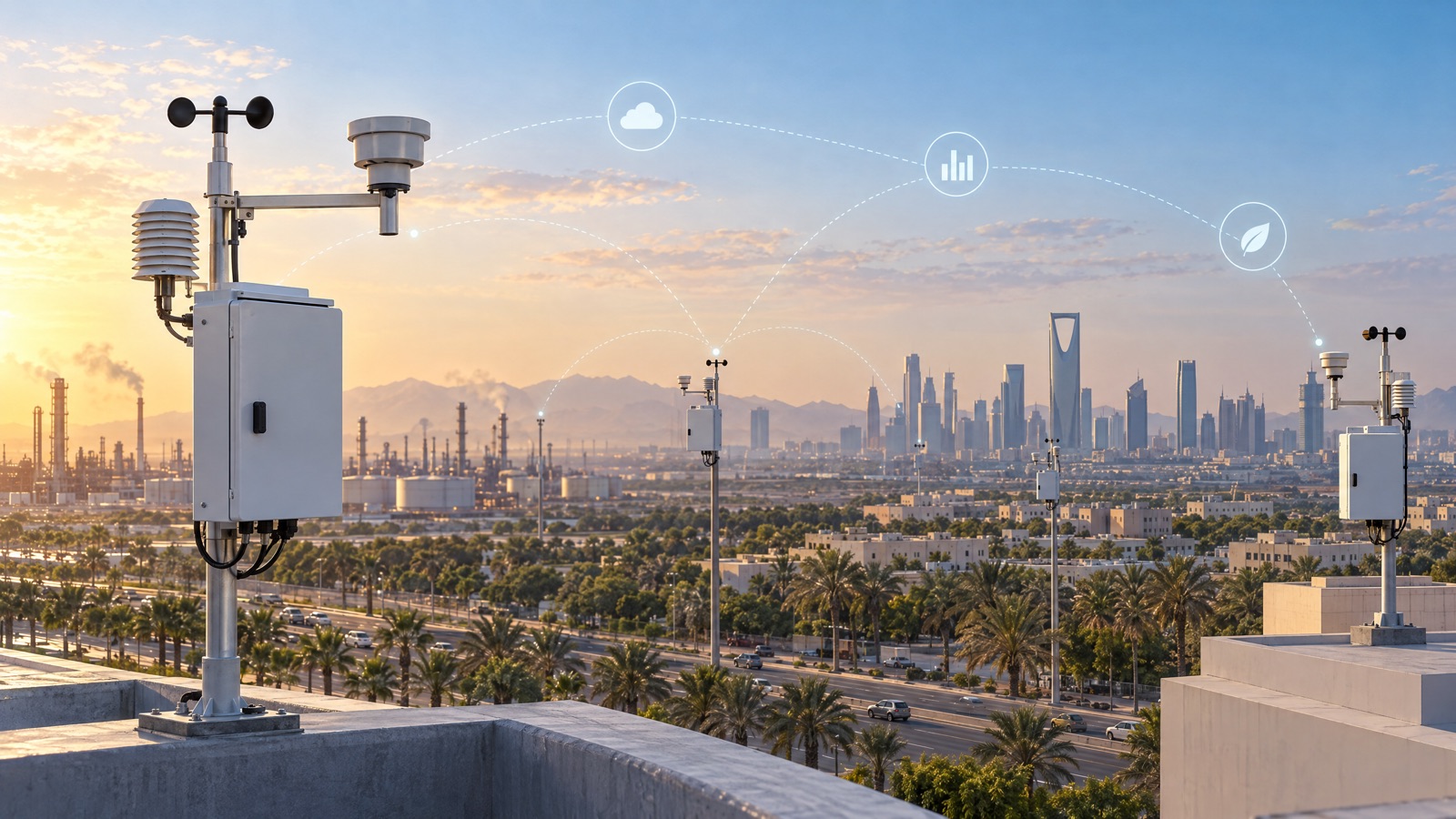
EnviroSaudi supplies and configures ambient air quality monitoring networks in Saudi Arabia for industrial operators, municipalities, developers, utilities, consultants and infrastructure contractors. A network can combine compact sensor nodes, higher-assurance stations, meteorological instruments, remote communications, dashboards and a documented operating plan. We define each station around the pollutant, expected concentration range, location purpose and action required from the data.
You receive a written proposal setting out the configuration, scope, lead time and price. Send the project boundary, proposed locations, target pollutants, data-quality objective and reporting needs to EnviroSaudi at /, or Request a quotation.
Network design begins with location purpose
A useful network does not place identical instruments at arbitrary points. Each location should answer a stated question. An upwind site can help describe incoming conditions; a downwind or boundary point can detect changes associated with site activity; a community or roadside location may represent a different exposure environment; and a background point can provide context. Access, security, inlet height, nearby obstructions, power, communications and maintenance safety also affect the design.
EnviroSaudi prepares a location schedule, parameter matrix and station class for review. Buyers needing the detailed siting workstream can use monitoring network design and instrument siting. Where wind and atmospheric conditions are important to interpretation, meteorological sensors and air-quality integration are included. Equipment supply and operational network design do not replace the permit, approved baseline-study plan or regulatory decision that applies to your project.
Ambient air quality monitoring network stations we supply in Saudi Arabia
The proposed network may use a mixed architecture rather than one equipment type everywhere. Compact nodes can provide greater spatial coverage. More capable stations can support a broader gas and particle suite, stronger sample management or comparison duties. The pollutant list may include PM1, PM2.5, PM10, ozone, nitrogen dioxide, sulfur dioxide, carbon monoxide, hydrogen sulfide, VOC indicators and weather parameters when these match the sources and objective.
Station quantity should follow the questions the network must answer, not a fixed density rule. A preliminary design should show source areas, prevailing wind sectors, sensitive receptors and the role of each proposed station, then test whether the layout remains practical when power, communications and safe access are considered. If the network combines sensor nodes with higher-assurance stations, the proposal should also identify which locations provide comparison or collocation data and how configuration changes will be controlled across the fleet.
The Aeroqual AQS 1 manufacturer page states that one configured AQS 1 can measure PM fractions plus up to four gases at the same time, selected from VOCs, ozone, NO2, CO, H2S, SO2, methane and benzene, together with environmental-sensor options. It describes a pumped, modular station with remote real-time data. The Scentroid CTair page lists up to 11 sensors across PID, NDIR, electrochemical, laser-particle and metal-oxide technologies, plus several communications options. These products illustrate different specification routes; model, module, range and interference checks remain part of project selection.
[Image placeholder]
Communications, dashboard and QA planning
A multi-station network needs consistent time, units, metadata and status information. The design can define:
- local buffering, cellular or wired communications;
- user roles, map and trend views;
- automated alerts and export formats;
- escalation paths for instrument faults.
The related environmental data dashboards and alerts page covers the operational data layer in more depth.
Quality planning should match the use of the results. The US EPA’s Air Sensor Toolbox explains that lower-cost and portable sensors are generally distinct from regulatory-grade monitors and provides resources for study design, performance evaluation and data interpretation. Its collocation guidance describes comparison with reference monitors as a way to evaluate sensor performance and accuracy. For a Saudi project, the relevant project specification and competent authority determine the required method; EPA resources are practical technical guidance, not a substitute for Saudi requirements.
An EnviroSaudi operating plan can include:
- incoming inspection and configuration records;
- collocation or comparison where specified;
- zero and span activities for suitable analysers;
- flow and inlet checks and preventive maintenance;
- data review rules, fault flags and calibration records;
- spare-parts planning.
Calibration, maintenance and spare-parts planning is scoped around the selected models and site access.
Saudi network applications and deliverables
Ambient network projects are available across Saudi Arabia, including Riyadh, Jeddah, Jubail, Yanbu, Dammam and Khobar. Riyadh urban and construction networks may need heat and dust planning, secure solar or mains power and dependable cellular coverage. Jeddah applications may require attention to humidity, salt-laden coastal conditions and port or traffic sources. Jubail and Yanbu industrial networks can combine boundary, community and meteorological locations around complex source areas. Dammam and Khobar projects may need coverage across industrial, logistics and populated zones. Large developments such as NEOM or Qiddiya may require repeatable station templates and common data rules across several packages.
Deliverables can include:
- network design basis, location and parameter schedule;
- proposed equipment classes and models, and bill of materials;
- power and communications plan;
- dashboard and alarm brief;
- installation notes and commissioning checklist;
- QA/maintenance plan, training requirements and handover records.
The proposal assigns civil works, mounting, electrical supply, SIM/data services and field responsibilities rather than leaving them implicit. Configuration, availability and lead time are confirmed in each quotation.
Frequently asked questions
Who provides ambient air quality monitoring network services in Saudi Arabia?
EnviroSaudi supplies and configures multi-station ambient networks for Saudi industrial, infrastructure, municipal and development applications, including ports, mines, logistics hubs and large developments in locations such as Riyadh, Jeddah, Dammam, Jubail and Yanbu. The scope can include station selection, network architecture, communications, dashboard requirements, commissioning checks and operating documentation.
How do I choose equipment for an ambient monitoring network?
A network can combine compact sensor nodes, modular gas-and-particle stations, higher-assurance analysers, weather sensors, data loggers, communications hardware and calibration accessories. Equipment class is selected for the required pollutants, range, data use and maintenance model.
How are monitoring locations selected?
Locations are assigned a purpose such as incoming/background conditions, source-boundary change, downwind response, roadside influence or community context. Wind, sources, receptors, obstructions, security, access, power and communications are reviewed before fixing the layout.
Can compact sensors replace reference monitors?
Not automatically. Compact sensors can add spatial and temporal coverage, but performance depends on the pollutant, range, environment, calibration and data objective. Collocation and comparison may be required, and the applicable specification determines whether a particular instrument class is acceptable.
What affects the cost of an ambient monitoring network?
Cost follows the number and class of stations, the pollutant list and ranges, communications and power arrangements, dashboard requirements, and the installation and maintenance scope. The quotation sets these out.
How long does ambient network delivery take?
Timing depends on station class and configuration, pollutant suite, site access, power and communications readiness, and field-work responsibilities. Lead time is confirmed in each quotation.
What inputs are needed for an ambient-network proposal?
Provide the project boundary and layout, source and receptor information, pollutant list and expected ranges, number or purpose of locations, applicable specification, power and connectivity, reporting interval, dashboard users, programme and field-work responsibilities.
Looking for an ambient air quality monitoring network in Saudi Arabia? Request a quotation and EnviroSaudi will set out the configuration, scope and lead time for your project.