
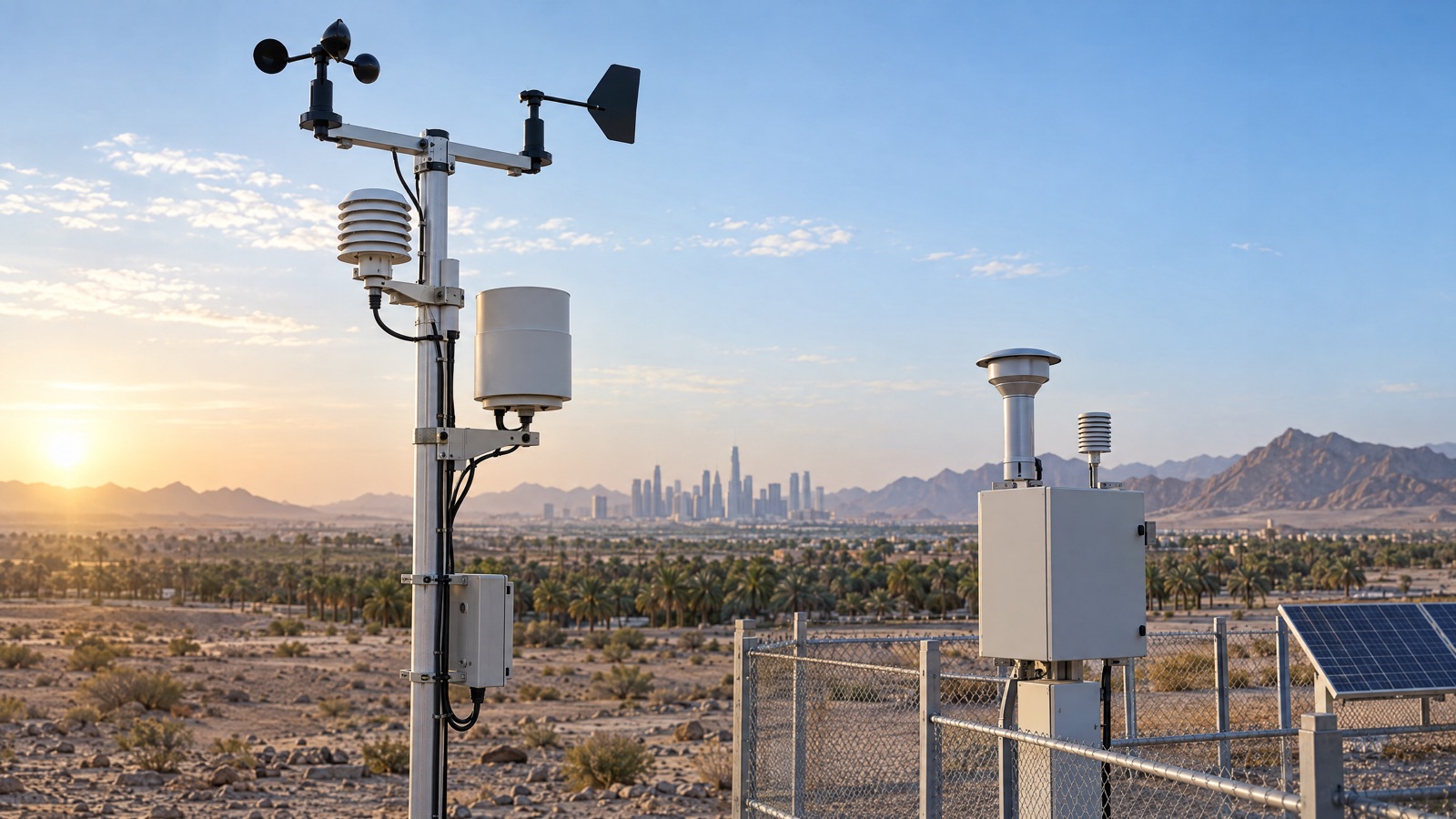
EnviroSaudi is a meteorological air quality monitoring supplier in Saudi Arabia, and weather data explains what an air monitor alone cannot: an air monitor shows when a concentration changed, while meteorological data helps explain where the air mass may have come from, whether the atmosphere favoured mixing or accumulation, and whether heat, humidity or rain may have affected the instrument or the local environment. For industrial sites, developments and urban networks in Saudi Arabia, that context can turn an isolated reading into a more useful operational lead.
You receive a written proposal setting out the configuration, scope, lead time and price. Request a quotation
Weather data is not proof of a source. A wind direction coinciding with a peak may identify an area for review, but buildings, terrain, thermal effects and rapidly changing winds can complicate the path. The sound approach is to align air and weather records, check data quality and combine them with site knowledge before drawing conclusions. Equipment supply does not replace the method, specialist study or regulatory decision that applies to your project.
What the main weather measurements add
Wind direction provides a first-pass indication of the direction from which air was moving at the sensor. Wind speed helps show whether conditions were calm, variable or strongly ventilated. Together they can support event screening: for example, comparing repeated concentration increases with operating areas that were upwind at those times.
Temperature and relative humidity help teams understand environmental conditions and possible instrument sensitivities. They also add context for daily patterns, such as afternoon mixing or humid coastal periods. Barometric pressure and rainfall may be useful where the monitoring objective, terrain or equipment method makes them relevant. A project does not need every available weather variable; it needs the variables that support the decisions being made.
The location and time basis matter as much as the parameter list. A wind sensor shielded by a wall or mounted beside an exhaust may not represent the airflow at the air monitor. Data with different clocks, time zones or averaging periods can create false comparisons. The meteorological sensors and air-quality integration solution explains the hardware and data-integration work behind a combined station.
A practical event-review workflow
Start by defining the question. Is the team checking a short gas alarm, a recurring particulate pattern, a boundary event or a difference between two stations? Then work through the review:
- Record the pollutant, unit, averaging interval, event time and data status.
- Review instrument-health flags, calibration or maintenance records and communications gaps before interpreting the value.
- Align the weather record to the same clock and interval.
- Plot concentration with wind direction and speed, not direction alone, and review conditions before, during and after the event; a five-minute snapshot may miss a wind shift.
- Compare nearby stations where available, then overlay relevant site information such as process areas, roads, earthworks, loading points or regional dust conditions.
- Write the conclusion at the strength the evidence supports.
“The event occurred while winds were generally from the north-east” is an observation. “The north-east unit caused the event” is a causal conclusion and requires more evidence. Repeated patterns may justify inspection, portable measurements, additional monitoring or a specialist investigation. Formal dispersion modelling and regulated study conclusions require a separate scope and suitable expertise.
Common problems that weaken interpretation
The first is poor siting. Rooftop turbulence, nearby structures, low mounting positions and obstacles can distort wind measurements. Monitoring network design and instrument siting considers the air inlet, weather sensor, access, power and communications as one system.
The second is weak time control. Station clocks should use a defined time standard, synchronise reliably and preserve changes made during service. The third is missing context: maintenance visits, generator testing, vehicle movements or construction activity should be logged so analysts can distinguish environmental events from local interference.
Saudi conditions add practical challenges. Dust can foul exposed equipment; high heat and solar loading can exceed a poorly selected installation envelope; coastal humidity and salt may affect maintenance needs. These are reasons to confirm manufacturer limits and inspection routines, not reasons to assume data is invalid. A documented quality-control process decides which data remains usable.
Meteorological air quality monitoring supplier: choosing the right approach
Fixed weather and air sensors are useful for continuous context at a defined location. Mobile and portable air monitoring can investigate areas that a fixed station does not cover, while an industrial fenceline air-monitoring network can compare multiple boundary locations. The method follows the decision: routine operations, screening, network optimisation or a formal investigation may need different equipment and evidence. Supply is available for projects across Saudi Arabia, including Dammam, Jubail and Riyadh.
This article addresses air-quality interpretation. It is not an odour-source attribution method, a regulatory dispersion model or proof that a particular facility caused a reading; those questions require a separately defined investigation with the appropriate measurements, records and technical review.
Frequently asked questions
Who is the meteorological air quality monitoring supplier in Saudi Arabia?
EnviroSaudi supplies meteorological sensors integrated with air-quality monitoring stations for projects across Saudi Arabia and prepares the configuration and quotation for each site.
Which meteorological parameters do I need with air monitors?
Wind direction and speed are usually the starting point. Temperature and relative humidity add environmental and instrument context; pressure and rainfall may also matter. Select parameters from the monitoring objective and the instrument method rather than installing a standard list without a use case.
Can wind direction identify the source of a pollution peak?
It can indicate which area was upwind, but it cannot prove the source by itself. Buildings, terrain, wind variability and multiple potential sources can affect interpretation. Treat it as evidence for screening and follow-up, not automatic attribution.
Should weather and air-quality sensors share a location and a clock?
Collocation can make comparisons easier, provided the location suits both measurements; in some networks a representative weather station serves several air stations. Use the same time zone, clock reference and compatible averaging intervals, and review raw resolution where possible, because a one-hour average can hide a short event or a wind change.
What affects the cost of meteorological monitoring with air quality stations?
Cost depends on the weather parameters selected, mounting and siting, number of stations, power and communications, data integration and maintenance arrangements.
How long does supply take?
Lead time depends on the configuration, number of stations and site readiness, and is confirmed in the quotation.
Is weather data enough for a formal air-quality investigation?
Usually not. It provides essential context, but the required evidence depends on the question. A formal study may also need approved methods, additional locations, source records, sampling, modelling and specialist analysis.
EnviroSaudi serves projects across Saudi Arabia, including Dammam, Al Khobar, Jubail, Riyadh, Jeddah, NEOM and Qiddiya.
Looking for a meteorological air quality monitoring supplier in Saudi Arabia? Request a quotation and EnviroSaudi will set out the weather and air-quality station scope for your site.