
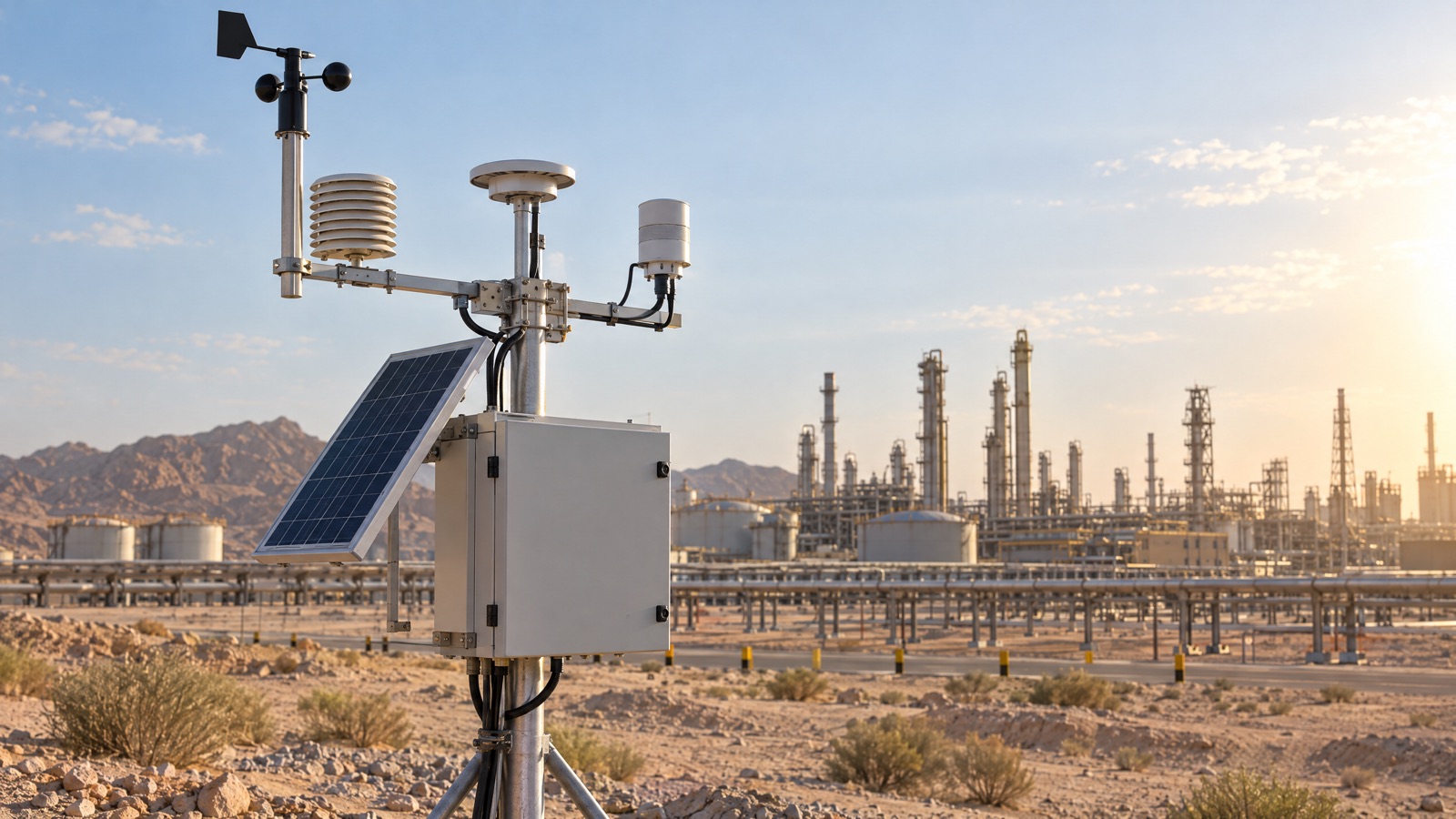
EnviroSaudi is a Scentroid SL50 air monitoring station supplier in Saudi Arabia, providing the configurable fixed SL50 Scentinal for continuous air-quality monitoring at industrial sites, infrastructure assets, developments and community-facing locations. The station combines multiple sensor technologies, local data storage, communications and alarm functions in a wall-mounted enclosure, and EnviroSaudi is an authorized Scentroid distributor.
You receive a written proposal setting out the configuration, scope, lead time and price. Request a quotation
The right configuration depends on the compounds or particles of interest, expected ranges, site conditions and how the results will be used. EnviroSaudi develops a project-specific configuration and delivery scope for Saudi Arabia. Configuration, availability and lead time are confirmed in each quotation.
When the SL50 is a practical fit
The SL50 is most useful where a project needs one fixed enclosure to monitor several parameters continuously and send results to authorised users. Typical air-quality roles include a facility boundary point, a utilities or waste-handling area, an industrial process perimeter, a logistics zone or a location that adds context to a wider network. It may be one component of an ambient air-quality monitoring network rather than a complete programme by itself.
A station should be selected from the monitoring objective backwards. Buyers should define:
- the target substances and likely concentration range
- the time resolution and data-quality expectation
- the location purpose
- the response to an alert
These inputs determine whether the SL50 sensor approach is suitable and which modules, sample inlet, communications and calibration provisions belong in the proposal. Equipment supply does not replace the permit, approved method or regulatory decision that applies to your project, and the station should not be described as equivalent to a reference analyser unless the applicable method and project evidence establish that conclusion.
Verified configuration and station features
Scentroid’s current product page states that the SL50 supports up to 20 sensing modules. The listed sensor categories are photoionisation detection, non-dispersive infrared, electrochemical, laser particulate and metal-oxide sensing. This breadth allows a proposal to be shaped around gases, volatile-organic-compound indicators and particulate measurements, but it does not mean every parameter is installed at once. Module compatibility, measurement range, potential interferences and environmental limits are confirmed for the selected build.
The manufacturer lists:
- a one-minute sampling rate, one or two sampling ports and a NEMA 4X cabinet suitable for wall mounting
- 3G/4G and LAN communications by default, with Wi-Fi also shown
- a 64 GB data-storage specification, a seven-inch touchscreen and connection to the SIMS3 platform
Those facts describe the current manufacturer offering; the final order identifies the exact hardware revision, modem bands, connectivity responsibilities and any software or licence scope.
Manual calibration using calibration gas is listed, with an optional automatic system using built-in calibration gas. A maintainable Saudi deployment still needs a documented approach for inspection, filters or consumables where applicable, calibration gas logistics, checks, records and fault response. See calibration, maintenance and spare-parts planning for the lifecycle workstream.
Data, alarms and network context
The manufacturer states that SL50 alarms can be delivered by SMS or email and can include a local audible alarm. Alarm thresholds are controlled project settings, not universal compliance limits. Your proposal sets out who approves each threshold, who receives an alarm, what verification occurs and what operational response follows. Communications loss, sensor fault and overdue maintenance may need separate notifications from concentration events.
For fleet use, Scentroid SIMS3 environmental data platform can centralise supported-device data, trends and alerts. A network may also incorporate meteorological and air-quality integration so wind data supports interpretation. Exact interfaces, user roles, retention, exports, cybersecurity controls and connectivity costs are agreed before supply.
Scentroid SL50 air monitoring station supplier: planning your Saudi deployment
Outdoor and semi-outdoor locations in Saudi Arabia can expose equipment to high heat, dust, solar loading, coastal humidity or salt, and difficult maintenance access. The manufacturer specification and the proposed installation arrangement are checked against the site’s actual environmental envelope. A weatherproof rating alone does not settle shading, inlet placement, mounting strength, power quality, sample-line design or safe access.
An EnviroSaudi proposal includes:
- the measurement objective, proposed modules and ranges
- a location schedule, enclosure and mounting requirements
- power and communications assumptions
- a dashboard and alarm brief
- commissioning checks, training and a maintenance plan
- a responsibility matrix
Network design and instrument siting is available where the location must be justified within a larger network. Projects are available across Saudi Arabia, including Dammam, Jubail and Riyadh.
Frequently asked questions
Who is the Scentroid SL50 air monitoring station supplier in Saudi Arabia?
EnviroSaudi supplies the Scentroid SL50 for projects across Saudi Arabia and prepares the configuration, delivery scope and quotation for each project.
What can the Scentroid SL50 monitor?
The available configuration can draw from photoionisation, non-dispersive-infrared, electrochemical, laser-particle and metal-oxide sensor categories. The manufacturer states support for up to 20 sensing modules. The exact gases, particle fractions, ranges and combinations are confirmed for the proposed unit.
Is the SL50 suitable for continuous outdoor monitoring?
It is presented by Scentroid as a fixed continuous monitoring station in a NEMA 4X wall-mount cabinet. Suitability depends on the site temperature, dust, humidity, solar exposure, mounting, inlet, power and maintenance conditions, all of which are reviewed for your project.
How does the station transmit data and send alarms?
Scentroid lists 3G/4G and LAN as default communications and also lists Wi-Fi, with SMS, email and local audible alarm functions. Thresholds, recipients and escalation steps are configured for the intended use; an alert indicates that a defined condition occurred, not a source or regulatory non-compliance.
What affects the cost of an SL50 station?
Cost depends on the sensor modules and ranges, sampling ports, calibration provisions, communications, mounting and power, platform scope and commissioning requirements. To start a proposal, provide the target parameters, monitoring objective, location, environmental conditions, connectivity and alarm recipients.
How long does SL50 delivery take?
Lead time depends on the configuration, manufacturer options, site readiness and commissioning requirements, and is confirmed in the quotation. Site photographs and layout drawings help resolve mounting and access requirements.
Where can I buy an SL50 air monitoring station in Saudi Arabia, and what limitations apply?
You can request a quotation from EnviroSaudi. Confirm sensor cross-sensitivities, detection range, environmental limits, calibration method, consumables, communications resilience and the evidential use of results, as a configured sensor station is not a substitute for a prescribed reference method without documented acceptance.
EnviroSaudi serves projects across Saudi Arabia, including Dammam, Al Khobar, Jubail, Riyadh, Jeddah, NEOM and Qiddiya.
Looking for a Scentroid SL50 air monitoring station supplier in Saudi Arabia? Request a quotation and EnviroSaudi will prepare the configuration and scope for your site.