
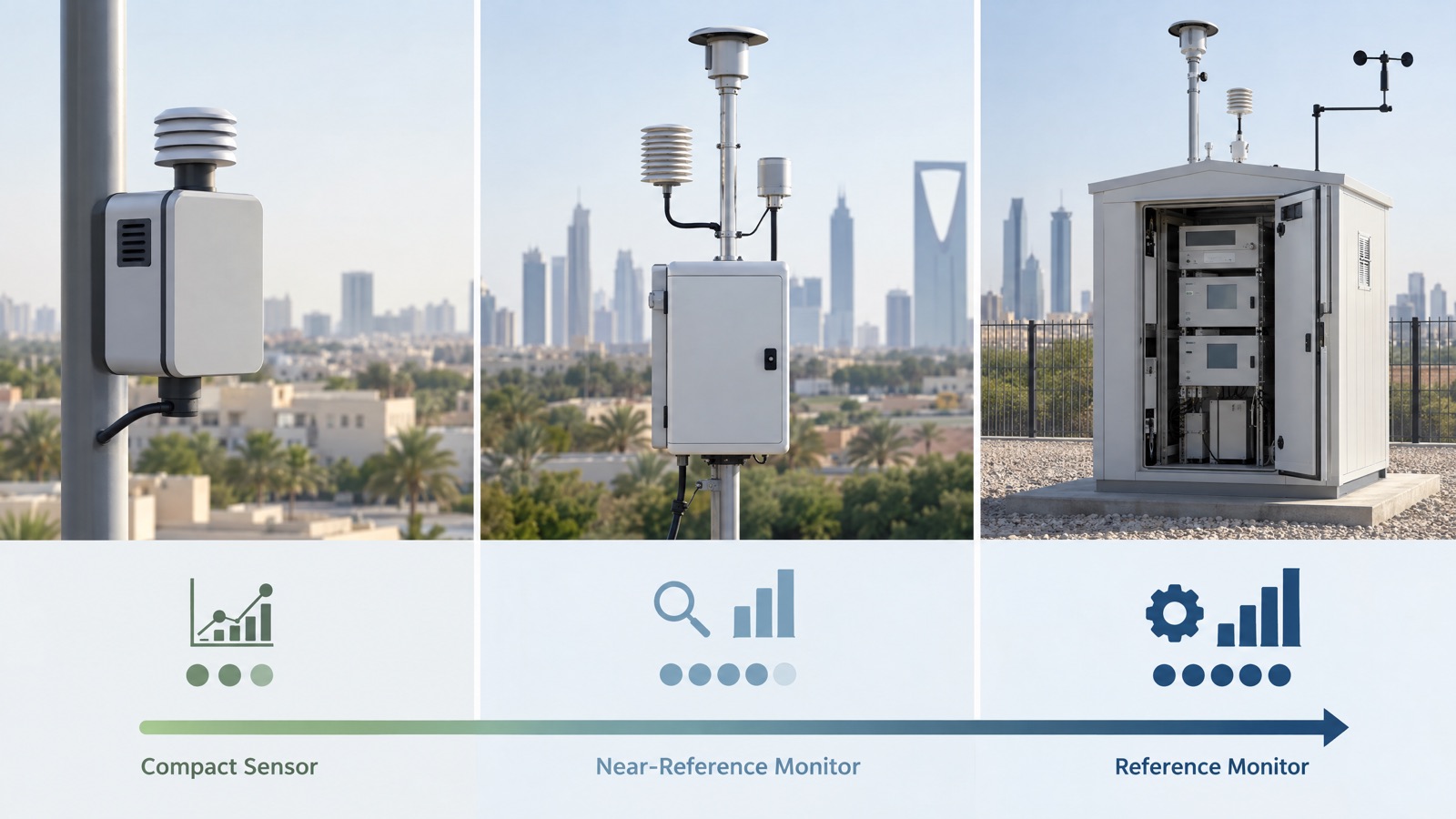
EnviroSaudi is a sensor-based and reference air monitoring supplier in Saudi Arabia, and air-monitoring proposals often use the terms “sensor-based,” “near-reference” and “reference” as if they were three universal equipment grades. They are not. Sensor-based describes a broad technology category. Near-reference is commonly a supplier or market performance description, not one globally defined regulatory class. Reference and equivalent methods have a formal meaning only within the scheme that designates them and when the prescribed configuration and procedures are followed.
You receive a written proposal setting out the configuration, scope, lead time and price. Request a quotation
For a Saudi project, the right choice starts with the intended decision. Operational alerts, spatial screening and formal compliance reporting can require different evidence, quality controls and instruments. A useful specification names the data purpose and governing requirement before it names a class of monitor. Equipment supply does not replace the method, permit or regulatory decision that applies to your project.
Sensor-based monitoring: coverage with a defined purpose
Sensor-based systems commonly use compact optical, electrochemical, metal-oxide, photoionisation or other sensing elements. They can make frequent measurements, support more locations and help teams see changes across a boundary, construction site or urban area. Typical uses include trend tracking, alerting, source investigation and deciding where a higher-specificity measurement is warranted.
Their value does not make every reading interchangeable with a regulatory result. Performance can depend on pollutant, concentration range, aerosol composition, temperature, humidity, interferents, inlet design, maintenance and data processing. Two units sold under the same family name may also contain different sensors or firmware configurations.
The US EPA Enhanced Air Sensor Guidebook recommends defining the monitoring question, selecting equipment for that use and planning setup, quality checks and interpretation. That use-case approach is more informative than calling a device “low cost” or “smart.”
Near-reference: a performance claim to examine
“Near-reference” is widely used to suggest stronger performance, a more controlled enclosure or a closer relationship to reference-style data than a basic sensor node. However, it is not a single formal method category with one acceptance threshold. The label alone does not identify which pollutant, range, averaging period, environment or comparison method was evaluated.
Ask what evidence sits behind the term:
- Was the exact configuration collocated, for how long and in what climate?
- What concentration range occurred and which metrics were reported?
- How were humidity and interferents handled?
- Do corrections remain valid after sensor or firmware changes?
A manufacturer may reasonably describe its product as near-reference, but that wording does not by itself grant compliance status in Saudi Arabia or elsewhere.
Reference and equivalent methods: designation matters
A reference method is tied to an applicable legal or technical framework. In the United States, for example, 40 CFR Part 53 establishes procedures for designating Federal Reference Methods and Federal Equivalent Methods for criteria pollutants, and the EPA publishes a current list of designated methods. That US framework illustrates why “reference” is not just a synonym for expensive or accurate equipment.
A designation applies to defined components, ranges, configurations and operating procedures. Changing an inlet, analyser configuration, software treatment or operating range can matter. Saudi projects must instead follow the method, authority instruction, permit condition or client specification actually governing the work. A US designation may be useful evidence, but it is not automatic Saudi acceptance.
Collocation improves understanding, not legal status
Collocation places instruments together so they experience substantially the same air. It can reveal bias, precision, drift, environmental effects and whether a correction is defensible for the observed conditions. It is especially valuable before distributing sensor nodes across sites with high heat, humidity, dust or coastal exposure.
Collocation cannot independently turn an undesignated sensor into a reference or equivalent method. A strong correlation over a limited campaign may not hold for a different pollutant mix, season, concentration range or aerosol. The comparison design, completeness, maintenance records and uncertainty all matter. Formal equivalence comes from the applicable designation process, not from a chart with a high correlation coefficient.
Sensor-based and reference air monitoring supplier: different systems can work together
A project may combine one carefully operated comparison station with more numerous sensor-based points. The higher-quality station can provide context and performance checks, while distributed nodes help identify spatial patterns or events. That architecture is useful only when each data stream is labelled by its purpose, status and quality controls. Dashboards should not visually flatten unlike measurements into one apparently equivalent dataset.
Procurement documents carry the same distinctions into acceptance tests, data fields and reporting language, and state how invalid, corrected and provisional data are marked, so a dashboard does not give every number the same apparent authority.
Start with a monitoring needs assessment and equipment selection when the required class is unclear. Project-specific routes cover ambient air-quality monitoring networks and dust and particulate monitoring. Once equipment is selected, calibration, maintenance and spares support is planned around the exact configuration. Supply is available for projects across Saudi Arabia, including Dammam, Jubail and Riyadh.
Frequently asked questions
Who is the sensor-based and reference air monitoring supplier in Saudi Arabia?
EnviroSaudi supplies sensor-based and reference-class air monitoring equipment for projects across Saudi Arabia and prepares the configuration and quotation around the data purpose and governing requirement.
Is near-reference a formal regulatory class?
Generally, no. It is commonly a performance or market description. Buyers should request evidence for the exact pollutant, configuration, conditions and intended use rather than rely on the label.
What makes a monitor a reference or equivalent method, and can collocation change that?
The monitor and method must be formally designated or accepted within the applicable framework and operated in the specified configuration and procedures; the governing Saudi requirement is checked for each project. Collocation can quantify performance and support quality control, but it does not confer a formal method designation.
Can sensor-based and reference systems be combined?
Yes. They can provide complementary spatial coverage and data-quality context when their roles, QA, metadata and limitations remain explicit.
What affects the cost of sensor-based or reference monitoring?
Cost depends on the monitoring class, pollutants and range, required uncertainty, number of locations, site conditions, communications and maintenance capacity.
How do I choose a monitoring class, and how long does supply take?
Define the decision, pollutants, expected range, averaging time, required uncertainty, governing method, site conditions, location count and how the data will be reported or acted upon. Lead time depends on the class and configuration and is confirmed in the quotation.
EnviroSaudi serves projects across Saudi Arabia, including Dammam, Al Khobar, Jubail, Riyadh, Jeddah, NEOM and Qiddiya.
Looking for a sensor-based and reference air monitoring supplier in Saudi Arabia? Request a quotation and EnviroSaudi will match the monitoring class to your decision.