
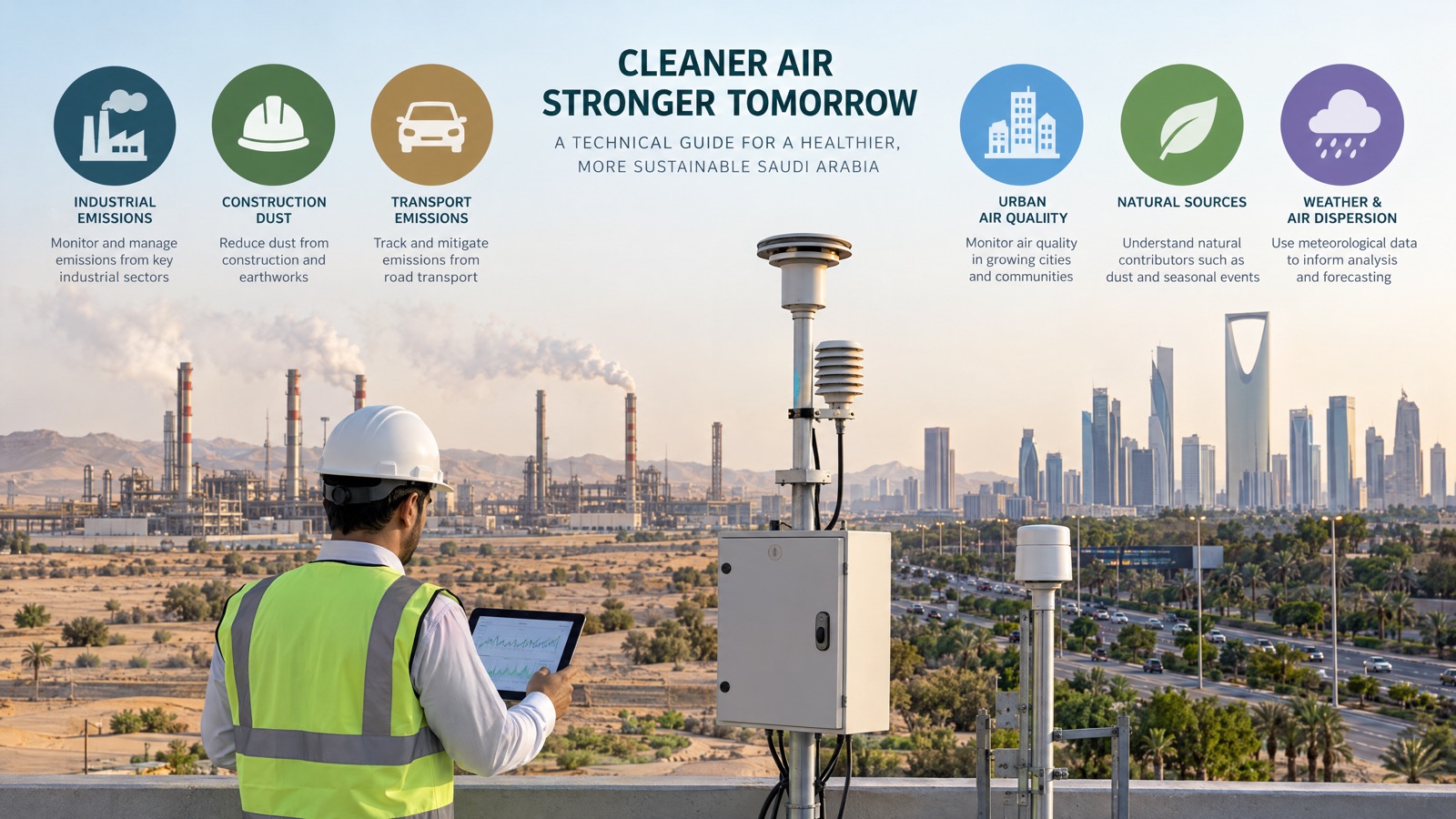
EnviroSaudi supplies industrial and urban air monitoring equipment in Saudi Arabia, matched to the sector, location and operating decision. Air-monitoring requirements vary by sector, location and operating decision. An industrial boundary, a construction package, a municipal network and a commercial building should not receive the same instrument list simply because each needs “air-quality data.” Parameters, measurement range, station density, siting, communications and maintenance must follow the application.
The starting point is a clear question: what must the buyer observe, where, at what time resolution and for which users? Formal impact assessment, permit preparation, dispersion modelling and sustainability strategy remain separate professional scopes.
You receive a written proposal setting out the configuration, scope, lead time and price. Request a quotation
Use public priorities without copying them into every project
The World Health Organization's global air-quality guidelines address PM2.5, PM10, ozone, nitrogen dioxide, sulfur dioxide and carbon monoxide. They provide health-based global context, but they are not a substitute for a Saudi project's applicable legal requirements, approved methods or local monitoring objective.
Saudi Arabia's National Center for Environmental Compliance describes oversight of monitoring for air and other environmental media, data analysis, surveys and reporting. Equipment buyers should confirm the current requirements that apply to their facility, project or authority relationship rather than treating a general article as regulatory advice.
Industrial air monitoring in Saudi Arabia: ranges, boundaries and operating context
Oil, gas, petrochemical, manufacturing, power and utility sites may need different layers of measurement. A facility-boundary network can observe trends at defined locations. Process or stack duties may require purpose-designed analysers and sample conditioning. Portable equipment can support screening, while weather data can add context to changing boundary readings.
Priorities should include target compounds and ranges, sensor interferences, non-classified or hazardous-area location, power, communications, data use and access for calibration. General outdoor enclosure ratings do not establish hazardous-area suitability. Buyers can start with oil, gas and petrochemical air monitoring or the wider manufacturing and process-industry route.
Dust-intensive operations and construction: movement and maintenance
Construction, mining, quarrying and cement activities often make particulate measurement, weather context and equipment maintenance central. Work fronts and sources move, so station purpose and location history need to remain visible in the data. Heavy dust loading can also affect inlets, filters, optics or enclosures, making inspection access and service frequency part of the design.
The mining, quarrying and cement dust-monitoring page addresses fixed and distributed equipment for those sectors. For major projects, construction and infrastructure monitoring covers relocatable stations and multi-package data workflows. Neither equipment route replaces a CEMP, EIA or formal regulatory study.
Urban air monitoring networks in Saudi Arabia: coverage, comparability and continuity
Urban networks may aim to compare neighbourhoods, observe corridors, support public information or identify areas for further investigation. A dense compact-sensor network can add spatial detail, but more nodes do not automatically create reference-grade evidence. The US EPA Air Sensor Toolbox provides resources on sensor performance, collocation and data interpretation, reinforcing the need to evaluate instruments for their intended use.
Municipal priorities include representative siting, station comparability, time synchronisation, communications coverage, local buffering, device health, maintenance access and a clear public-data policy. The municipalities, smart cities and urban networks page provides the Saudi equipment route.
Ports and logistics areas: mixed sources and long operating hours
Ports, logistics hubs and industrial zones can combine vessel or vehicle activity, material handling, warehouses, nearby roads and neighbouring facilities. A useful network separates station roles: boundary context, activity-area trends, background comparison and portable follow-up. Wind data can help organise observations but cannot by itself establish source attribution.
Power and communications resilience matter where sites operate continuously or cover large areas. Review the ports, logistics hubs and industrial zones page for network and equipment considerations.
Commercial buildings: indoor parameters and controls boundaries
Building teams may monitor carbon dioxide, particulate matter, selected gases, temperature and humidity according to the space and operating question. Priorities include representative room placement, occupant patterns, update rate, dashboard visibility and how faults or high readings are handled. Measurement does not purify air and does not replace ventilation design.
Where monitors connect to building controls, device interfaces must be verified and approved controls contractors retain responsibility for control logic, interlocks and life safety. See commercial buildings, facilities and BMS contractors for that application.
Match equipment class to the question
A fixed configurable station such as Scentroid CTair can combine selected gas and particle sensors, local storage and communications. A portable platform such as Scentroid TR8+ can support screening with configurable sensing, a pump, GPS and logging. These are different roles; neither product family should be specified before the parameters, ranges, data-quality need and site constraints are understood.
EnviroSaudi's industries and applications hub helps buyers select the relevant route. For a cross-sector requirement, provide the Saudi locations, operating questions, target parameters, intended users, power, communications and current specifications so one coherent monitoring concept can be developed.
Frequently asked questions
Who provides industrial and urban air monitoring in Saudi Arabia?
EnviroSaudi supplies and integrates air-monitoring equipment for oil and gas, petrochemical, manufacturing, power, utilities, construction, mining, cement, municipalities, ports, logistics and commercial buildings, subject to site and project requirements.
Should every network monitor the same pollutants?
No. Parameters should follow likely sources, background conditions, expected ranges, intended decisions, applicable requirements and the capabilities and limitations of the selected measurement technology.
When is a portable instrument useful?
Portable equipment can support screening, changing work areas and follow-up checks. It is not automatically a permanent station, personal-safety device, laboratory method or regulatory reference analyser.
Can wind data identify the source of an elevated reading?
Wind can add useful directional context, but it does not prove source attribution by itself. Formal attribution or dispersion modelling requires a separate scope and appropriate evidence.
How do I choose industrial or urban air monitoring equipment for my site?
Provide locations, sectors, operating questions, parameters, expected ranges, measurement duration, data users, power, communications, access constraints and applicable project or authority specifications, and EnviroSaudi develops one coherent monitoring concept.
What affects the cost of air monitoring equipment?
Cost depends on the parameters and ranges required, the number of stations, hazardous-area or enclosure needs, power and communications, software and maintenance requirements.
How long does it take to supply an air monitoring network?
Timing depends on the equipment class and configuration, the number of stations, site access and commissioning scope. Configuration, availability and lead time are confirmed in each quotation.
EnviroSaudi serves projects across Saudi Arabia, including Dammam, Al Khobar, Jubail, Riyadh, Jeddah, NEOM and Qiddiya.
Need industrial and urban air monitoring in Saudi Arabia? Request a quotation and tell us your sector, locations and monitoring question.