
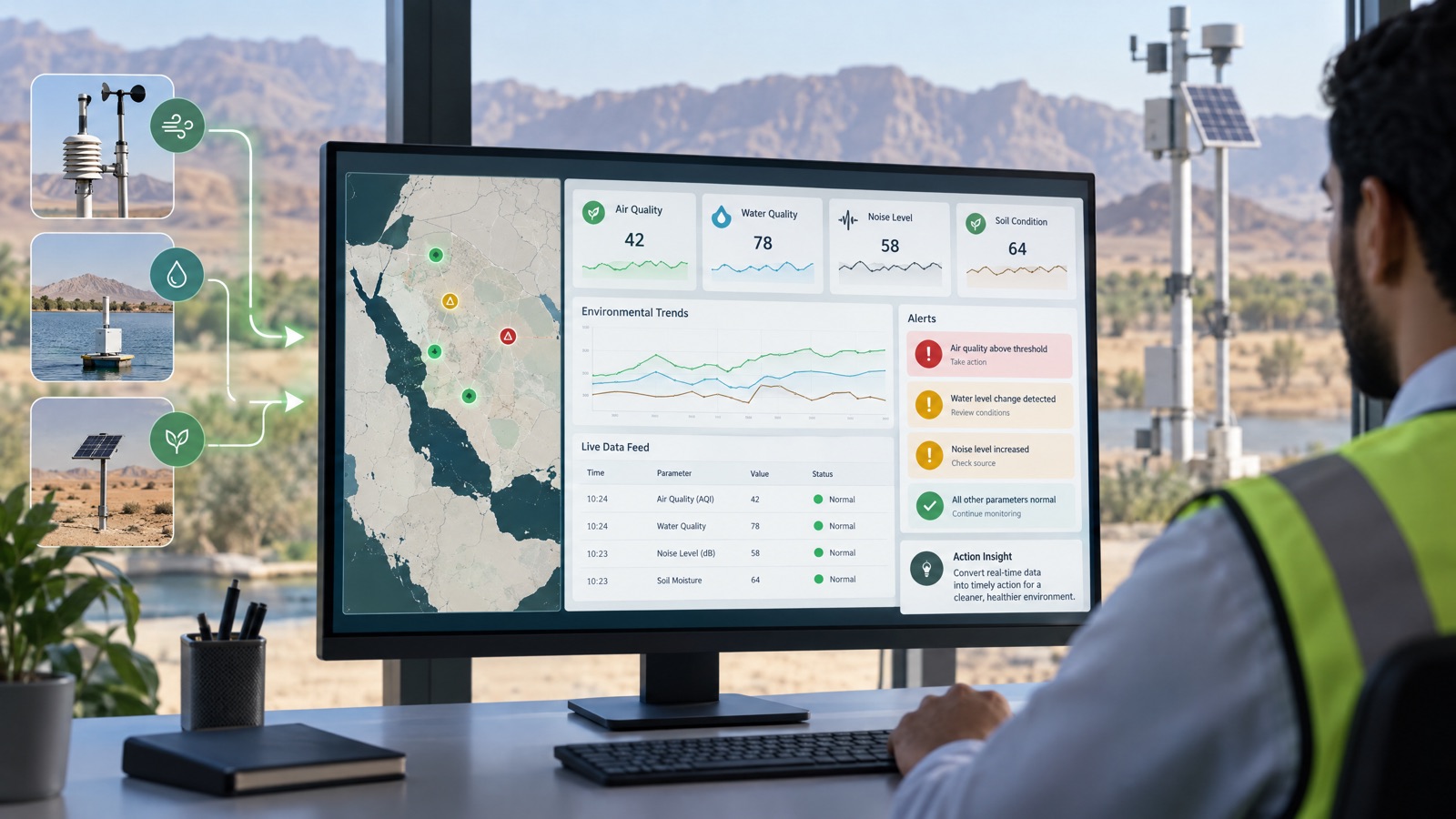
EnviroSaudi is a real-time air monitoring dashboard supplier in Saudi Arabia, providing the alert and reporting layer that helps someone decide what to do next. Without agreed thresholds, data states and responsibilities, frequent messages can leave users unsure which events require inspection, technical review or management escalation.
You receive a written proposal setting out the configuration, scope, lead time and price. Request a quotation
A practical alert framework connects each rule to an objective, reliable input, recipient and documented response. Reports show what happened, how the system performed and which actions remain open. This suits Saudi facilities and networks where multiple instruments and teams share a platform. Equipment and dashboard supply does not replace the method, permit or regulatory decision that applies to your project.
Real-time air monitoring dashboard supplier: start with the decision, not the dashboard
Define the purpose of every alert before configuring software. One rule might prompt a technician to check an inlet; another might ask an environmental team to review a concentration pattern; a third might indicate lost communications. These events have different owners and response times even if they appear on the same screen.
A clear rule records the parameter, unit, location, averaging interval, comparison basis and applicable data status. It also states any persistence period, delay or return-to-normal condition. These details prevent a short noisy value from being treated like a sustained event and reduce repeated notifications while an acknowledged condition remains open.
Thresholds come from the approved project basis. They may be instrument-health limits, internal operational levels, manufacturer conditions or formally applicable criteria. A platform setting does not turn an internal threshold into a legal limit, and an exceedance notification does not by itself prove non-compliance or identify a source.
Separate three types of alert
Instrument-health alerts cover faults that threaten data availability or quality: sensor diagnostics, failed calibration checks, abnormal flow, power interruptions or an overdue service task. Communications alerts cover missing transmissions, gateway problems and offline stations. These should reach technical owners before users assume that a blank chart means clean air.
Measurement alerts concern a concentration or environmental condition. They state whether the input is raw or provisionally screened. A recipient may need to check diagnostics, nearby stations, weather and operating records before escalating it. Where public, safety or regulatory communication may follow, agree the approval chain and competent authority requirements in advance.
Operational workflow alerts track human action: an event acknowledged, an inspection overdue or a corrective task still open. This layer is easy to neglect, but it converts notification into accountability. The environmental data dashboards, alerts and BMS interfaces solution addresses the integration work; this article focuses on designing the operating rules around it.
Build an escalation path people can follow
For each alert, nominate a primary recipient and backup. State the first check, evidence to capture, time allowed and person who can close or escalate the event. Keep contact groups current and test delivery.
A useful sequence is:
- Confirm the station is online.
- Review health flags and check persistence.
- Compare nearby instruments and weather.
- Inspect relevant activity.
- Record the finding.
Adapt the sequence to the hazard; urgent safety procedures always take precedence.
Avoid sending every rule to every manager. Technical faults should go first to maintainers, while verified patterns and unresolved actions may move to environmental or operations leaders. Scheduled test alerts, acknowledgement records and periodic review of false or repetitive alarms help keep the system credible.
Protect the meaning of the data
Display data status visibly. “Raw,” “provisional,” “reviewed” and “validated” have documented definitions, not cosmetic labels. Preserve original readings, health flags, configuration changes and user actions. If a value is corrected, excluded or annotated, keep the reason and approver in an audit trail.
An alert includes enough context to act: station and parameter names, timestamp and time zone, current value and unit, comparison basis, duration, data status and a direct route to the relevant trend. It does not expose sensitive facility information to an uncontrolled recipient list.
The Scentroid SIMS3 environmental data platform is one product route for supported device data, visualisation, reports and alerts. Exact device compatibility, interfaces, user roles, retention, notification services, licences and cybersecurity arrangements are confirmed for the proposed deployment. Supply is available for projects across Saudi Arabia, including Dammam, Jubail and Riyadh.
Make reports answer operational questions
Different audiences need different reports:
- A daily operations view may show active alerts, station availability and maintenance due.
- A technical quality report may include completeness, invalid periods, calibration results and unresolved anomalies.
- A management summary may focus on recurring events, response time and corrective-action status.
State the reporting period, time zone, units, averaging method, data status and exclusions. Use trends and event tables with clear captions rather than dense screenshots. Include both environmental results and system health; otherwise a quiet month caused by offline instruments can look deceptively positive.
This is operational monitoring and reporting, not corporate disclosure, emissions-inventory assurance or carbon accounting. Those uses require their own definitions, controls and ownership. Likewise, reports from an ambient air-quality monitoring network do not replace a permit submission unless the competent authority and approved method say they do.
Frequently asked questions
Who is the real-time air monitoring dashboard supplier in Saudi Arabia?
EnviroSaudi supplies real-time air monitoring dashboards, alerts and reports for projects across Saudi Arabia and prepares the platform scope and quotation for each project.
What information should an air-quality alert contain?
Include the station, parameter, timestamp and time zone, value and unit, averaging interval, threshold basis, duration, data status and a link to the trend. Add the required first action and escalation contact where appropriate.
How do I set up real-time air monitoring alerts without alarm fatigue?
Use objective-specific thresholds, persistence rules, clear return-to-normal logic and targeted recipient groups. Review repetitive or false alarms, but document and approve rule changes so useful warnings are not silently suppressed.
What is the difference between measurement and instrument-health alerts, and should alerts use raw or validated data?
A measurement alert concerns the observed environmental value; an instrument-health alert indicates that data quality or availability may be compromised, and they usually need different owners. Real-time alerts often use raw or provisionally screened data, so the notification states that status and requires verification before a formal conclusion.
What affects the cost of a real-time air monitoring dashboard?
Cost depends on the number of stations and parameters, alert and report rules, user roles, integration targets, notification services, licences, retention and cybersecurity requirements.
How long does dashboard setup take?
Lead time depends on the device list, platform scope, alert design, integrations and user setup, and is confirmed in the quotation.
Can a dashboard alert prove regulatory non-compliance?
Not by itself. The result must be assessed against the applicable requirement, method, averaging basis, data validity and authority process. A configured alarm is a prompt for action, not an automatic legal determination.
EnviroSaudi serves projects across Saudi Arabia, including Dammam, Al Khobar, Jubail, Riyadh, Jeddah, NEOM and Qiddiya.
Looking for a real-time air monitoring dashboard supplier in Saudi Arabia? Request a quotation and EnviroSaudi will set out the alerts, reports and platform scope for your network.