
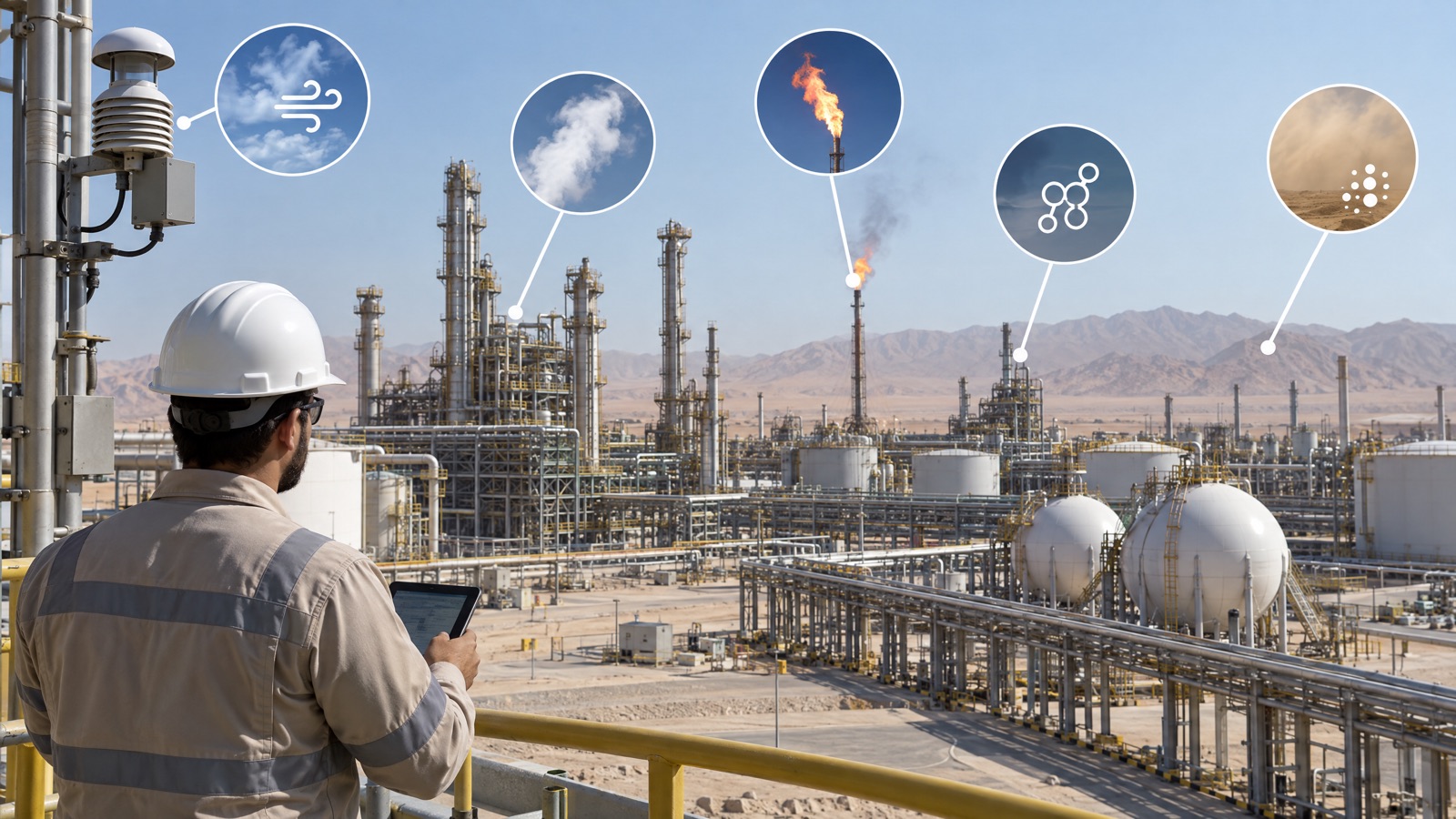
EnviroSaudi is a petrochemical air monitoring supplier in Saudi Arabia, providing monitoring equipment for oil, gas and petrochemical facilities that rarely have just one air-monitoring question. Operations may need stack measurements, worker-area warnings, boundary trends, volatile-organic-compound screening, hydrogen-sulfide awareness, particulate data and meteorological context, and trying to make one device answer all of them can create blind spots and misleading conclusions.
You receive a written proposal setting out the configuration, scope, lead time and price. Request a quotation
A better starting point is a facility map linked to decisions. Identify emission points, storage and transfer areas, process units, utilities, roads, nearby receptors and prevailing access constraints. Then define who will use each measurement and what action it should support. This article is an equipment-and-network planning guide for Saudi facilities. Equipment supply does not replace the permit, approved method or regulatory decision that applies to your project, and the final scope follows site risk processes.
1. Stack and combustion-source monitoring
Fired heaters, boilers, turbines, incineration or other combustion sources may require periodic testing, process indicators or continuous measurements, depending on the source and applicable requirement. Target substances, ranges, sample conditioning, analyser shelter, calibration provision and data acquisition are considered as one system.
Continuous emissions monitoring systems address this source-level equipment and integration scope. A CEMS is not interchangeable with an ambient sensor station: it handles a defined gas stream, measurement location and method.
2. Boundary and nearby-receptor context
Facility-boundary monitoring can show how selected gases or particles vary by place and time. It may support operational awareness, event screening and comparison across upwind and downwind locations. The network design considers target compounds, expected ranges, prevailing and variable winds, nearby activities, terrain, safe access, power, communications and maintainability.
One downwind station cannot represent an entire perimeter under every wind condition. An industrial fenceline air-monitoring solution can combine fixed points, but the station count and locations follow the monitoring objective. Boundary readings do not by themselves prove which unit or neighbouring activity caused an event.
3. VOC and hydrocarbon screening
Storage tanks, loading areas, wastewater interfaces, process equipment and maintenance activity may create different volatile-organic-compound monitoring needs. A total-VOC or photoionisation signal can be useful for rapid screening, but it is not automatically compound-specific. Methane, non-methane hydrocarbons, benzene or other target compounds may require different instruments and methods.
Define whether the task is fixed trending, portable inspection, area protection or compound-specific measurement. Review detection range, cross-sensitivity, humidity effects, sample path and calibration basis. Leak detection and repair programme design, formal source testing and laboratory analysis are separate scopes even where their information is compared with live monitoring.
4. H2S and other priority gases
Hydrogen sulfide is a key consideration in sour-gas, wastewater, sulfur-handling and some refining contexts. The monitoring approach reflects whether the decision is worker safety, process-area warning, boundary awareness or environmental reporting. Those uses can require different locations, response times, ranges and approvals.
Other gases may include sulfur dioxide, nitrogen oxides, carbon monoxide, ozone, ammonia or process-specific substances. Select them from site knowledge and the applicable project basis rather than copying a generic panel. Safety detection systems also have distinct performance, alarm and certification requirements; an environmental monitor is not a replacement for them.
5. Particles, dust and site activity
Roads, stockpiles, earthworks, handling operations and regional dust can influence particulate measurements. PM10, PM2.5, total suspended particles or dust-deposition methods answer different questions. Instrument location and inlet design must avoid obvious local interference while remaining representative of the intended area.
Compare particulate events with wind, visibility, operations and other stations. A high reading during regional dust should not be automatically assigned to the facility, while a local activity should not be dismissed without evidence. Portable equipment can support follow-up; see mobile and portable air monitoring for the equipment-selection route.
6. Meteorology and operational records
Wind speed and direction help teams interpret which areas were upwind during an event. Temperature, humidity, pressure and rainfall may provide additional environmental or instrument context. The sensor needs a defensible location and the same time basis as the air data. Meteorological sensors and air-quality integration covers the combined hardware and data path.
Operational logs complete the picture. Record shutdowns, startups, maintenance, flaring or combustion events, loading, construction and unusual traffic in a controlled timeline. Access respects site security, but reviewers need enough context to interpret patterns responsibly.
Petrochemical air monitoring supplier: turn priorities into a maintainable system
For each monitoring point, document:
- the objective, parameter, method and range
- the location rationale, power and communications
- data status and alarm response
- the calibration/maintenance plan and owner
Define which data is for screening, operational management, safety or formal reporting. Build spares, consumables, access permits and harsh-environment protection into the lifecycle plan.
The oil, gas and petrochemical air-monitoring industry page is the commercial route for a tailored equipment scope, available for projects across Saudi Arabia, including Dammam, Jubail and Riyadh. Odour diagnosis and source attribution, environmental permitting and dispersion studies, and greenhouse-gas inventories remain separate specialist intents. They may use some of the same site records, but they are not part of an equipment supply project automatically.
Frequently asked questions
Who is the petrochemical air monitoring supplier in Saudi Arabia?
EnviroSaudi supplies air monitoring equipment for oil, gas and petrochemical facilities across Saudi Arabia and prepares the equipment scope and quotation for each site.
Which pollutant should an oil or petrochemical site monitor first?
There is no universal first pollutant. Begin with applicable requirements, process knowledge, source characteristics, safety systems, nearby receptors and the decision the measurement must support. Then select a suitable method and range.
Can one monitor cover the stack, process area and fenceline?
Usually not. Those locations involve different sample conditions, ranges, response needs and evidence requirements. A coordinated platform may display several systems, but the measurement hardware must suit each duty.
Is a total-VOC reading the same as a benzene result?
No. A total or broad VOC response can be useful for screening but is not automatically selective for benzene. Compound-specific decisions require an appropriate analyser or sampling and analytical method.
How do I choose H2S monitoring locations at a petrochemical site?
Use the monitoring purpose, potential sources, dispersion conditions, occupied areas, safe access and applicable safety or environmental requirements. Worker-safety and environmental boundary systems should not be conflated.
What affects the cost of petrochemical air monitoring?
Cost depends on the parameters and ranges, source-level versus boundary or area duty, number of points, power and communications, calibration, maintenance and spares, and integration responsibilities.
How long does supply take, and what should be confirmed before procurement?
Lead time depends on the configuration and site readiness and is confirmed in the quotation. Confirm objectives, parameters, ranges, methods, locations, environmental limits, power, communications, data and alarm rules, calibration, maintenance, spares, integration responsibilities, applicable approvals and acceptance tests.
EnviroSaudi serves projects across Saudi Arabia, including Dammam, Al Khobar, Jubail, Riyadh, Jeddah, NEOM and Qiddiya.
Looking for a petrochemical air monitoring supplier in Saudi Arabia? Request a quotation and EnviroSaudi will set out the monitoring priorities and equipment scope for your facility.