
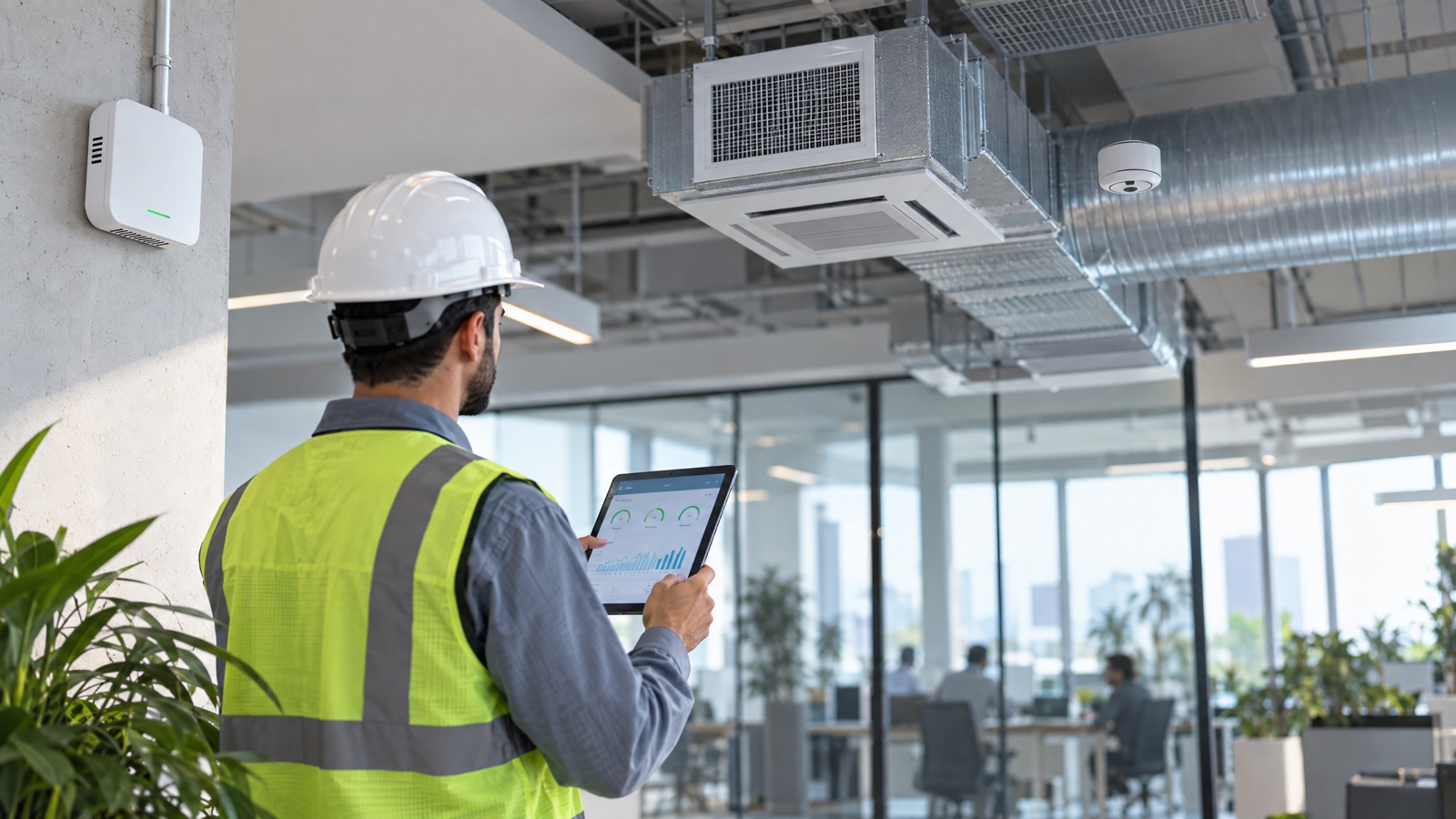
This guide explains how to monitor indoor air quality in commercial buildings in Saudi Arabia, so teams can understand occupied spaces, identify recurring patterns and check operational changes. Monitoring is useful when measurements are tied to zones, occupancy, ventilation and a defined response, not when one reception sensor is treated as proof for the whole property.
You receive a written proposal setting out the configuration, scope, lead time and price. Request a quotation
For Saudi commercial buildings, planning reflects high outdoor temperatures, dust, coastal humidity, long cooling seasons and varied occupancy. The aim is a maintainable system that informs facility decisions within each sensor’s limits. Monitoring does not replace the ventilation design, building requirement or regulatory decision that applies to your project (see the boundary section below).
Define the building question first
A monitoring brief names the decision: investigating complaints, reviewing ventilation patterns, comparing floors or creating operator alerts. The question determines parameters, locations, time resolution and duration.
Start with a zone schedule covering occupancy, ventilation system, activities, outdoor-air intakes and complaint history. Group similar spaces, but do not assume a meeting room represents an open office or kitchen-adjacent area.
The indoor air quality and ventilation monitoring solution is the equipment-selection route. This article explains how to frame the measurement plan before a device or network is specified.
How to monitor indoor air quality: choose parameters for their intended use
Carbon dioxide can indicate occupancy and ventilation patterns when interpreted with outdoor concentration and system operation. It does not represent every indoor pollutant, and a low value does not prove the absence of particles, gases or biological concerns.
Temperature and relative humidity provide comfort and environmental context. Particle measurements may compare indoor patterns with outdoor dust or activities. VOC indicators may show relative changes, but a broad response does not identify compounds. Other gases require a justified source pathway and risk basis.
Select ranges, resolution and accuracy from the decision and applicable guidance. More parameters do not automatically create a better programme; they can add maintenance and interpretation burden without improving action.
Place sensors where they can represent the zone
Avoid supply diffusers, return grilles, open doors, local sources and direct sunlight unless that influence is under study. Consider mounting height, security, power and service access. Record every position change.
An outdoor comparison point near the relevant intake can add context, provided the instrument suits that environment. One point may not represent every façade.
Temporary measurements can test locations before rollout. Compare similar zones and check whether readings respond plausibly to occupancy and plant schedules. Investigate placement, time alignment and instrument condition before drawing building-wide conclusions.
Connect trends to ventilation and occupancy
Review occupied and unoccupied periods, schedules and seasonal conditions. Compare air-handling modes, outdoor-air damper commands, filter changes and complaints. A command value is not proof of delivered airflow; mechanical verification may be needed.
Define alert rules with the parameter, unit, averaging period, persistence and recipient. Separate a measurement alert from a sensor fault or communications outage. An operator should know whether to inspect the space, check occupancy, review the plant, call a technician or escalate to the HVAC engineer.
Where devices feed a building management system, confirm the exact interface, point list, update interval, units, data ownership and cybersecurity requirements. The Scentroid HW20 HVAC Warden product page is the product-specific route, while environmental data dashboards and BMS interfaces covers broader operational integration. Protocol availability is verified for the ordered configuration.
Keep the boundary clear: measurement is not treatment
An IAQ monitor measures selected conditions; it does not remove particles, dilute gases or purify air. A dashboard cannot correct a blocked filter, poor outdoor-air path, moisture problem or unsuitable operating sequence. Monitoring shows where and when to investigate and helps evaluate changes, while corrective design belongs to the facility, MEP, controls or hygiene specialist.
This article does not design an HVAC system, calculate required ventilation rates, commission air balance or certify that a building is “healthy.” Applicable building requirements and ventilation standards are interpreted by qualified project professionals. If control integration is proposed, agree safeguards, authority and fail-safe behaviour before allowing data to influence plant operation. The monitor integration, training and handover service makes those responsibilities explicit.
Plan for trustworthy operation
The handover includes:
- an asset and zone register, sensor configuration and installation drawings
- baseline observations, alarm rules and user permissions
- a calibration or verification plan, and a cleaning and replacement schedule
- data-status definitions and escalation contacts
Training shows staff how to distinguish a genuine pattern from a fault and to record changes in occupancy, fit-out or HVAC operation.
Periodic review asks whether the locations remain representative, the devices are operating within their stated conditions and the reports still support action. For portfolios, begin with a defensible pilot, learn from different zone types and then standardise. The commercial buildings and BMS contractor page is the sector route for a project-specific system scope, available for projects across Saudi Arabia, including Dammam, Jubail and Riyadh.
Frequently asked questions
Who is the indoor air quality monitoring supplier in Saudi Arabia?
EnviroSaudi supplies indoor air quality and ventilation monitoring for commercial buildings across Saudi Arabia and prepares the zone-based scope and quotation for each project.
How do I monitor indoor air quality in a commercial building, and which parameters do I need?
Common candidates include carbon dioxide, temperature, relative humidity, particles and a VOC indicator, but the correct set depends on the space, sources and decision. A low carbon-dioxide reading does not prove good indoor air quality, because it does not represent every pollutant.
How many indoor-air sensors does a building need?
There is no universal ratio. Base the count on distinct zones, occupancy patterns, HVAC systems, risk, floor layout and the need for representative coverage. A pilot can test assumptions before wider deployment.
Can IAQ sensors control the BMS automatically?
They may provide inputs where a verified interface and approved controls design exist. The controls contractor and building team define sequences, limits, fallback states and authority. A monitor should not be connected to automatic control without that review.
Can a monitor purify indoor air or fix ventilation?
No. It measures selected parameters and provides evidence for investigation or operational response. Purification equipment, ventilation design, air balancing, maintenance and remediation are separate actions.
What affects the cost of indoor air quality monitoring?
Cost depends on the number of zones and sensors, parameters, BMS or dashboard integration, power and communications, pilot scope, calibration or verification, and maintenance arrangements.
How long does supply and installation take?
Lead time depends on the configuration, number of zones, integration scope and site access, and is confirmed in the quotation.
EnviroSaudi serves projects across Saudi Arabia, including Dammam, Al Khobar, Jubail, Riyadh, Jeddah, NEOM and Qiddiya.
Ready to put how to monitor indoor air quality into practice in your building? Request a quotation and EnviroSaudi will set out the zone-based monitoring scope for your building.