
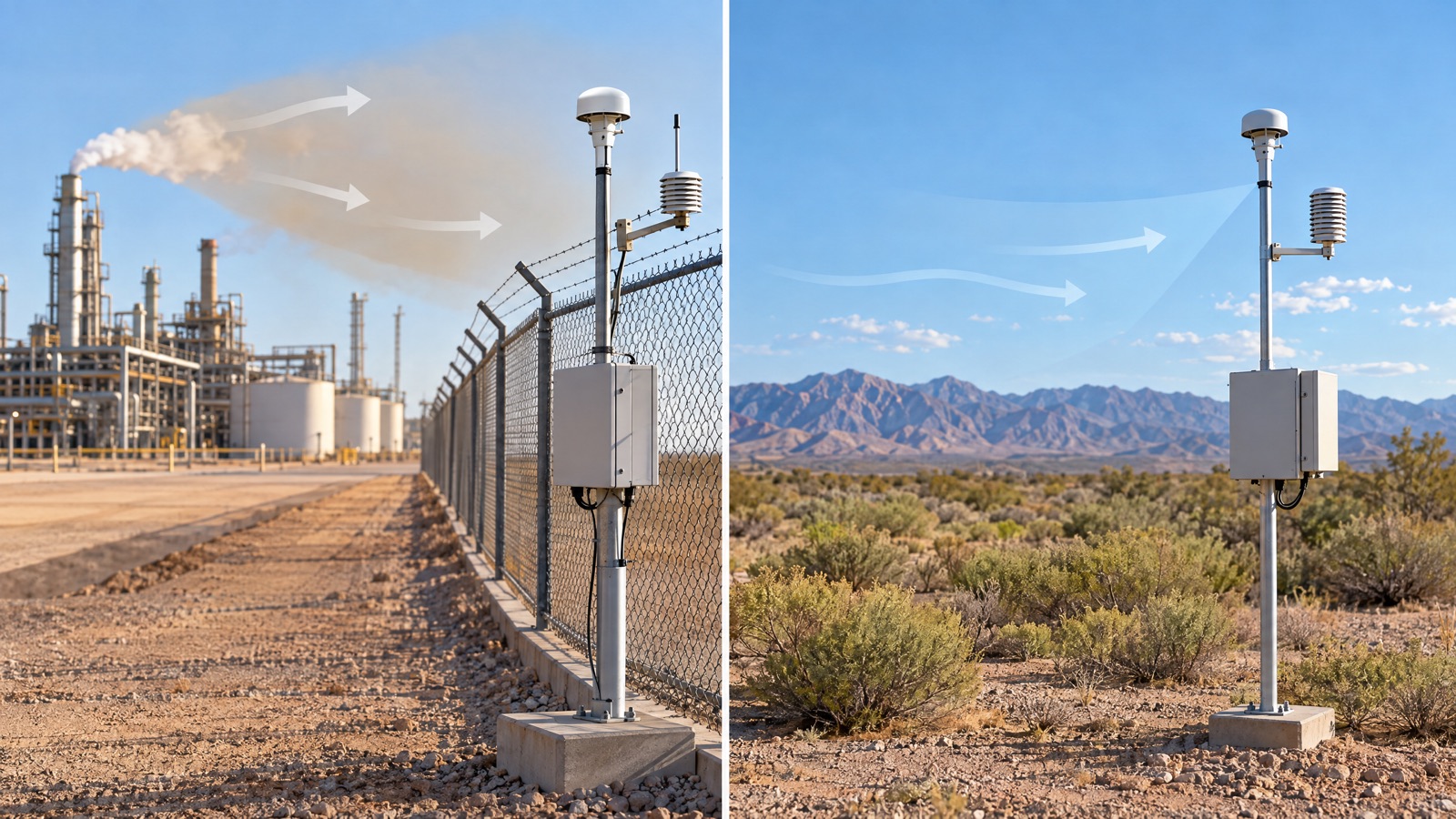
EnviroSaudi is a fenceline and ambient air monitoring supplier in Saudi Arabia, and the two approaches use similar instruments but answer different questions. A Saudi plant may need to detect changes around its own boundary, while an industrial zone, authority or developer may need a broader picture of outdoor air across several communities or land uses.
You receive a written proposal setting out the configuration, scope, lead time and price. Request a quotation
Choosing by equipment name alone can produce stations in the wrong places and data that cannot support the intended decision. The practical starting point is not “Which monitor should we buy?” It is “What must the network show, where must it show it, and what action follows?” Once those answers are clear, the project team can decide whether the primary architecture is fenceline, ambient or a combination.
Fenceline monitoring is source-and-boundary focused
Industrial fenceline monitoring places measurement points around or near a defined facility boundary. The objective may be to observe changes associated with tanks, process areas, waste handling, loading, vehicle movement or bulk-material operations. Upwind or background context can help distinguish a site-related pattern from conditions arriving from elsewhere.
Locations follow the source layout, boundary geometry, wind sectors, nearby receptors, access and utilities. A single “downwind” station is rarely enough because wind direction changes. The network may therefore include several boundary points, a contextual location and meteorological measurements. Short reporting intervals and event alerts can support operational review, but a concentration peak plus wind direction does not automatically prove which source caused it.
Readers planning that equipment-led scope can continue to industrial fenceline air monitoring. Odour complaints, human-sensory work and odour-source attribution belong to the separate specialist odour route rather than a general air boundary network.
Ambient monitoring represents a wider area or population
Ambient monitoring is designed around outdoor conditions at a broader spatial scale. A network may represent urban background, roadside conditions, industrial influence, a development area or several communities. Its stations are selected to represent defined monitoring objectives rather than simply surrounding one property.
That difference changes the planning inputs. An ambient network may need a mixture of station types, with locations selected for population exposure, background context, transport influence or regional patterns. It may combine higher-performance stations with supplementary sensor nodes, but each class needs a stated purpose and data-quality expectation. The ambient air-quality monitoring networks page covers procurement and integration after the objective is defined.
Fenceline and ambient air monitoring supplier: compare the decision, not just the map
Four questions usually separate the two approaches:
- What is the principal subject: one operating site or the air across a wider area?
- What spatial pattern matters: movement across a boundary or differences among neighbourhoods, roads and background locations?
- Who must respond: plant operations, a project team, an authority or several asset owners?
- Does the requirement specify a recognised method, averaging period or formal reporting route?
The pollutant list can overlap. Both architectures may include PM2.5, PM10, selected gases, VOC indicators and weather data. However, the expected concentration range, required sensitivity and interpretation differ. A boundary monitor close to an intermittent source may need fast event visibility. A wider ambient station may need stable long-term comparability and a location that remains representative as local activities change.
When a combined network makes sense
Some projects need both layers. A large petrochemical area might use facility-boundary stations to support operator response and wider ambient locations to understand conditions across shared industrial and community areas. A port or logistics development might combine source-proximate dust stations with background points outside the active handling zones.
Combination does not mean every station must carry the same instruments. A better design assigns a job to each location, then selects the instrument class, parameter set, reporting interval and QA plan for that job. Shared weather data and consistent time stamps help compare events across layers. The meteorological sensors and air-quality integration route explains the operational weather layer.
Data presentation should preserve those roles. Station metadata, status flags and method labels help users avoid comparing an operational boundary alert directly with a long-term ambient statistic as though they were equivalent results. The reporting plan also defines who sees each alert, who validates it, and when a boundary event is escalated into a wider network review.
Build the scope before requesting equipment
A useful planning note states the site or study boundary, sources, receptors, decisions, pollutants, likely ranges, time resolution, reporting need and responsible users. It identifies available power, communications, access and security, as well as any hazardous-area or civil-work constraints. The monitoring network design and instrument siting service is the commercial next step when these inputs are ready. Supply is available for projects across Saudi Arabia, including Dammam, Jubail and Riyadh.
Equipment supply does not replace the permit, approved method or regulatory decision that applies to your project. Formal baseline studies, permit submissions and dispersion modelling remain separate professional scopes, and this article does not determine a Saudi regulatory requirement.
Frequently asked questions
Who is the fenceline and ambient air monitoring supplier in Saudi Arabia?
EnviroSaudi supplies fenceline and ambient air monitoring equipment for projects across Saudi Arabia and prepares the station scope and quotation for each site.
What is the main difference between fenceline and ambient monitoring?
Fenceline monitoring is organised around a defined facility boundary and source-related events. Ambient monitoring represents outdoor air across a wider area, population, road corridor or background setting. One project can use both, provided every station has a clear objective and data-quality requirement.
Do fenceline and ambient networks measure different pollutants?
Not necessarily. Both may measure particles, selected gases, VOC indicators and weather. The important differences are the objective, expected range, location, time resolution and method required for the decision.
How many monitoring stations are needed, and what affects the cost?
There is no universal number. Source geometry, wind sectors, site size, receptors, terrain, access, power and the required spatial coverage determine the location schedule, and the same factors together with instrument class and communications drive cost.
Why is weather information important in both designs?
Wind speed and direction provide context for changing concentrations, while temperature and humidity may affect instruments and interpretation. Weather supports analysis but does not prove source attribution by itself.
How do I choose between fenceline and ambient monitoring, and how long does delivery take?
Prepare the layout, source and receptor map, monitoring objective, pollutant list, expected ranges, averaging and reporting periods, applicable specification, utilities, access conditions and response responsibilities. Delivery time depends on station class, quantity and site readiness, and is confirmed in the quotation.
EnviroSaudi serves projects across Saudi Arabia, including Dammam, Al Khobar, Jubail, Riyadh, Jeddah, NEOM and Qiddiya.
Looking for a fenceline and ambient air monitoring supplier in Saudi Arabia? Request a quotation and EnviroSaudi will set out the right architecture and station scope for your site.