
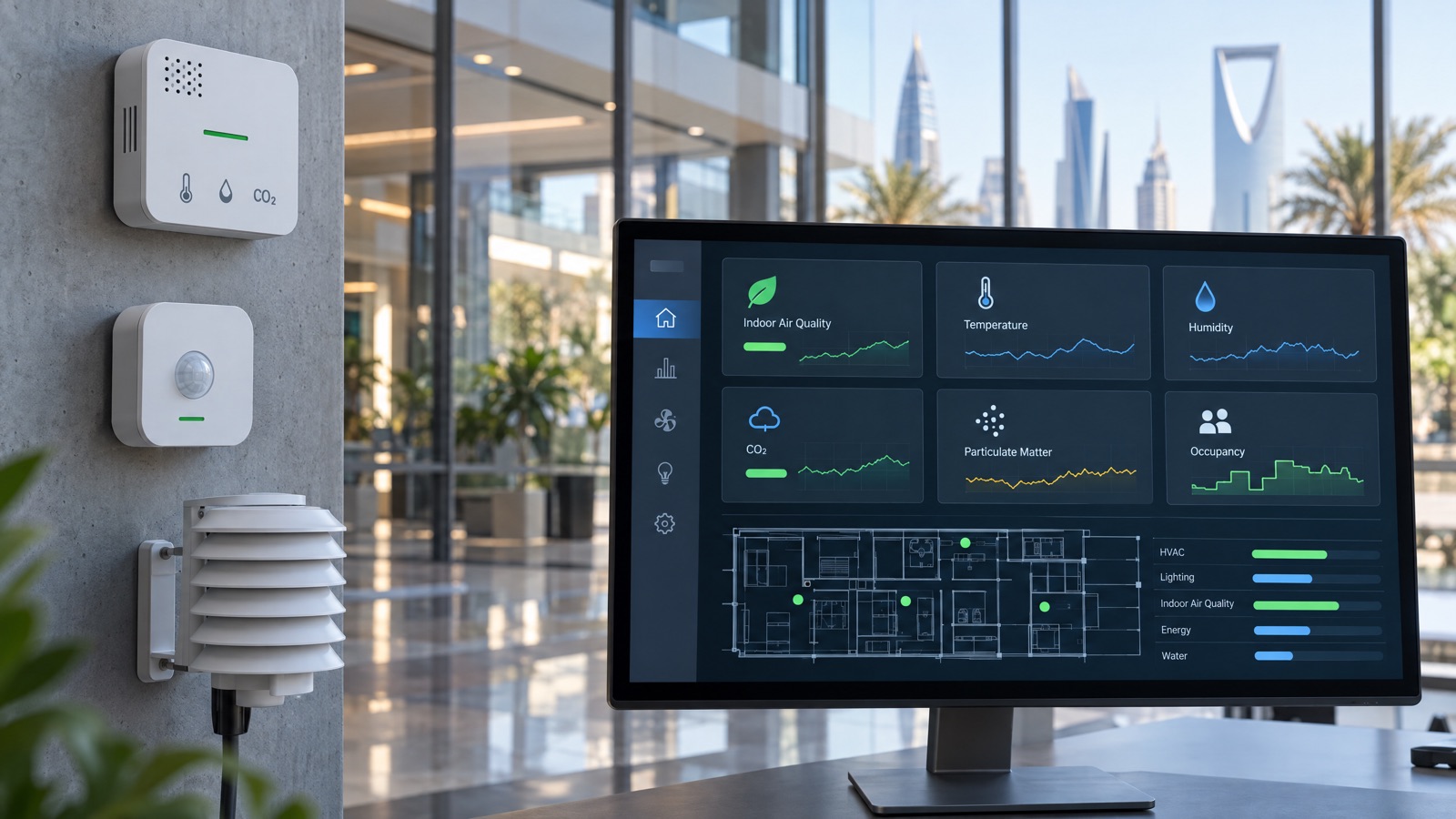
This guide explains how to integrate environmental monitors with a BMS in Saudi Arabia, linking monitors to BMS platforms, dashboards and existing systems for building, industrial and infrastructure projects. An environmental monitor does not become integrated simply because both systems have network ports. A useful connection needs a verified device interface, an agreed point list, consistent units and timestamps, defined alarm ownership, cybersecurity review and an acceptance test. These decisions should be made before procurement—not after instruments reach site.
EnviroSaudi selects compatible monitors, configures the monitor side, prepares point information, coordinates with dashboard or BMS contractors and documents handover. The appointed controls or IT contractor remains responsible for head-end programming, control logic, interlocks, life-safety functions, cybersecurity and final acceptance within the approved design. See the dedicated environmental monitor and BMS integration service for a project scope.
You receive a written proposal setting out the configuration, scope, lead time and price. Request a quotation
Begin with the data that users need
Start by listing each parameter, engineering unit, device identifier, location, sample or update interval, quality/status flag and intended user. A facilities operator may need current carbon-dioxide and particulate readings plus device status. An environmental manager may need historical trends, exports and maintenance flags. A control-system integrator needs a precise object or register map, addressing rules and read/write permissions.
The use case determines the interface. A local building network may favour BACnet or a hard-wired output. An industrial gateway may use Modbus. A fleet dashboard may receive data through vendor software or a documented web API. These examples are not interchangeable, and a protocol name does not prove that every desired data point or function is implemented.
Some architectures also use an edge gateway between monitors and the receiving platform. The specification should state whether that gateway performs protocol conversion, buffering, time synchronisation or unit conversion, and what happens if it fails. Keeping raw device identity and quality flags visible helps prevent a converted value from appearing more reliable or current than the underlying measurement.
Verify protocol support at model and configuration level
ASHRAE describes BACnet as a communication protocol for building automation and control networks. A real project still needs the device's BACnet implementation details: network type, supported objects and services, writable points, alarm behaviour and addressing. Likewise, the Modbus Organization maintains the Modbus protocol suite, but integration requires the exact register map, data types, byte order, scaling, polling limits and exception behaviour for the selected device.
Manufacturer evidence must be equally specific. Scentroid's HW20 HVAC Warden page lists BACnet, Modbus, current and voltage outputs. That supports those examples for a verified HW20 configuration; it does not prove that another monitor supports them. The CTair product page lists Modbus TCP/IP among its communications options, so the ordered model and interface documentation must be checked before design.
Dashboard and API options: how to integrate environmental monitors with a BMS
A vendor dashboard can offer useful maps, trends, alarms, diagnostics and reports without exposing a public API. Scentroid's SIMS3 information describes historical analysis, diagnostics, settings and supported-device management. Its public page should not be used as evidence of an API unless separate current documentation for that interface is provided.
Where an HTTP API is genuinely available, request its versioned description, endpoints, authentication method, rate limits, timestamps, units, status fields, error responses and change policy. The OpenAPI Specification is a language-agnostic way to describe HTTP API capabilities, but using OpenAPI does not itself make a device or platform compatible. The selected vendor must supply the applicable interface documentation and access terms.
The environmental dashboards, alerts and BMS interfaces solution can help buyers compare these paths. For product-level dashboard capability, review the SIMS3 environmental data platform.
Preserve control and cybersecurity boundaries
Environmental readings can inform operators and approved control sequences, but monitor integration should not silently transfer control responsibility. The controls designer decides whether a value is advisory, used in an approved sequence, or excluded from automatic action. The design should define fail-safe behaviour for stale, missing, implausible or out-of-range data and should keep life-safety functions on their approved systems.
Network responsibilities also need names. The customer or appointed IT party should approve addressing, segmentation, firewall rules, remote access, accounts, credential storage, patching and logging. EnviroSaudi can provide monitor-side requirements and coordinate tests; it does not assume ownership of the customer's enterprise network.
Test the complete operational path
Acceptance should prove more than a live connection. For each agreed point, verify identity, value, unit, timestamp, update frequency, status and display. Test communications loss, restart and recovery. Confirm how alarms are generated, delayed, acknowledged and escalated, and show operators how to distinguish a concentration event from an instrument or network fault.
Record the final point list, settings, drawings, user roles, test results, known exceptions and responsibility matrix. The installation and commissioning service can coordinate the monitor-side checks and handover evidence.
Frequently asked questions
Who provides environmental monitor BMS integration in Saudi Arabia?
EnviroSaudi supplies compatible monitors and provides monitor-side integration: verifying monitor interfaces, configuring supported communications, preparing point information, coordinating with controls or dashboard contractors, witnessing data exchange, training operators and documenting handover.
Does a BACnet or Modbus label guarantee compatibility?
No. Compatibility depends on the exact model, installed option, protocol version, supported objects or registers, data types, permissions and receiving system, and these must be checked before procurement and commissioning. The same applies to APIs: the public SIMS3 page confirms dashboard and data-management functions, not a universal public API, so an API is included only when current documentation and access terms for the selected configuration are available.
Can environmental data automatically control ventilation?
Only within an approved controls design. Authorised controls parties retain responsibility for sequences, limits, interlocks, fail-safe behaviour, life safety and final validation. Monitor data can be supplied and tested within that boundary.
What should an integration point list contain?
It should identify device and location, parameter, unit, object or register, data type, scaling, update rate, read/write status, alarm ownership, quality flag and expected behaviour during communications loss.
How do I integrate environmental monitors with a BMS at my site?
Provide monitor models and options, the receiving platform, network architecture, required points, controls or IT contacts, cybersecurity requirements, user workflows, alarm intent and the approved control responsibility matrix.
What affects the cost of environmental monitor integration?
Cost depends on the number of monitors and points, the protocols and gateways involved, coordination with controls or dashboard contractors, and the testing and documentation required. Pricing is set out in your quotation.
How long does integration take?
Duration depends on the availability of interface documentation, the number of points, contractor coordination, network approvals and the scope of acceptance testing. Configuration, availability and lead time are confirmed in each quotation.
EnviroSaudi serves projects across Saudi Arabia, including Dammam, Al Khobar, Jubail, Riyadh, Jeddah, NEOM and Qiddiya.
Ready to plan how to integrate environmental monitors with a BMS on your project? Request a quotation and we will respond with a proposal for your monitors, platform and point list.