
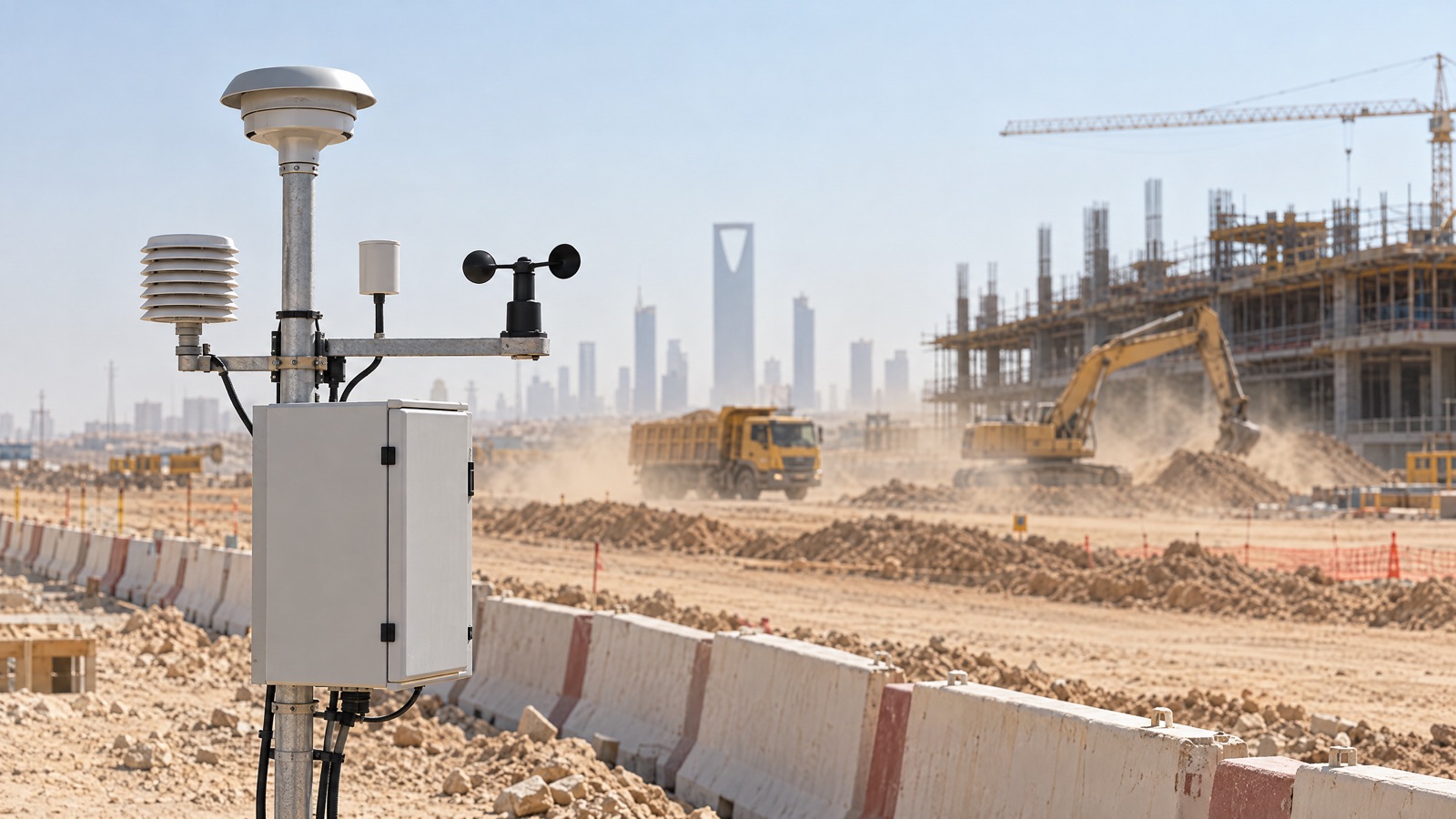
EnviroSaudi is a construction dust monitoring supplier in Saudi Arabia, providing dust and PM monitoring equipment that follows the work rather than being installed once and forgotten. Excavation, demolition, concrete cutting, stockpile handling, vehicle movement and fit-out activities create different particle patterns, so the monitoring plan connects locations, work phases, weather and response actions from the start.
You receive a written proposal setting out the configuration, scope, lead time and price. Request a quotation
Saudi projects add practical demands: dry conditions, regional dust events, high temperatures, long boundaries, changing work fronts and, in coastal locations, humidity and corrosion. A live system helps teams review trends and respond to site events. Equipment supply does not replace the permit, approved method or regulatory decision that applies to your project, including the project’s formal environmental plan and the applicable limit.
Map dust-generating activities and receptors
Begin with the phase plan and site layout. Mark excavation zones, demolition areas, crushers or batching activities, haul roads, gates, stockpiles and material-transfer points. Then identify nearby homes, offices, schools, hospitals, public roads, neighbouring work packages and sensitive site areas.
The US EPA’s AP-42 material on fugitive dust identifies heavy construction, unpaved roads, aggregate handling and wind erosion as distinct source categories. That source-based view is useful for planning even when AP-42 emission factors are not being used. It reminds the project team that “construction dust” is not one uniform activity.
Decide what the data must trigger
Possible objectives include confirming that dust controls are operating, alerting a site team to a sustained increase, comparing an active work area with an upwind location, documenting regional dust context or supplying trend data to the appointed environmental manager. Each objective needs a named user and response.
The project specification or responsible consultant sets the parameters, averaging periods, action levels and escalation route. A single transient reading may require a persistence rule or field check before action. EnviroSaudi configures the data workflow around those project limits.
Select particle fractions and supporting measurements
PM10 is often relevant to coarser construction dust, while PM2.5 can add context for combustion and finer particles. Some projects may specify TSP, PM1 or particle counts. The selected fraction must match the project requirement and the intended comparison; labels that look similar are not automatically interchangeable.
Wind speed and direction help teams review whether a change coincides with an active work area, an off-site direction or regional conditions. Rainfall, temperature and humidity can add operational context and affect instrument performance. Weather supports interpretation but cannot prove one source caused a reading.
Construction dust monitoring supplier: plan locations and relocation by phase
A practical layout may include an upwind or contextual point, downwind boundary locations and stations near important receptors. Positions should avoid walls, exhausts and obstructions that distort airflow, while remaining secure and accessible for cleaning and checks. Power, cellular coverage, mounting and protection from site traffic are part of siting, not afterthoughts.
As excavation ends and work moves to another zone, the original layout may stop representing the main sources. Define relocation triggers in advance, such as:
- phase changes
- major stockpile moves
- new haul routes
- handover between work packages
Every move updates the station ID and coordinates and includes a documented setup and function check.
Understand optical-monitor limits
Many real-time PM monitors use light scattering and convert the optical response into an estimated mass concentration. Aerosol composition, particle size and moisture can affect that relationship. A heated inlet or compensation feature may reduce a specific influence, but it does not make every optical monitor equivalent to a reference method.
If the project requires comparison with a formal method, specify collocation, parallel sampling or another approved route. The US EPA Air Sensor Toolbox provides official guidance on study design, performance evaluation and collocation. The dust and particulate monitoring systems page covers equipment options after the method requirement is clear.
Commission before relying on alerts
Record the exact monitor, inlet, mounting height, coordinates, configuration and time settings at installation. Verify flow, communications, local storage and alarm delivery, then review an initial period against weather, site activity and any comparison instrument. This commissioning record helps distinguish a genuine change in dust from an installation, clock or communications problem.
Routine checks cover inlet cleanliness, filters, flow or pump status, enclosure condition, power and data completeness. After a move or sensor replacement, repeat the relevant checks and flag the change in the dataset rather than treating the record as uninterrupted.
Connect readings to site events and records
Time-synchronised event logs make live data more useful. Record excavation, cutting, vehicle peaks, water-suppression changes, complaints, regional dust and maintenance. Alerts identify the station, parameter, threshold, duration and recipient. The response record can note verification, control action and return to normal without claiming automatic source attribution.
The construction site air monitoring systems page covers commercial deployment, while construction, infrastructure and megaproject monitoring addresses multi-package programmes. Supply is available for projects across Saudi Arabia, including Dammam, Jubail and Riyadh. CEMP preparation, permitting and formal impact assessment remain with the appointed qualified party.
Frequently asked questions
Who is the construction dust monitoring supplier in Saudi Arabia?
EnviroSaudi supplies construction dust and PM monitoring equipment for projects across Saudi Arabia and prepares the configuration, location plan and quotation for each site.
Should a construction project monitor PM10 or PM2.5?
The project requirement and dust sources determine the fractions. PM10 often supports coarser-dust review, while PM2.5 can add finer-particle and combustion context. Some projects specify other fractions.
How do I choose construction dust monitoring locations, and when should a monitor be relocated?
Locations may include upwind context, downwind boundaries, active work areas and sensitive receptors, depending on wind, obstructions, access, security and power. Relocate when work fronts, haul roads, stockpiles or receptor risks change, with updated coordinates and recommissioning checks.
Can an optical dust monitor be treated as a reference instrument?
Not automatically. The required method determines acceptability. Optical response can vary with aerosol and environment, so collocation or parallel measurement may be needed.
What affects the cost of construction dust monitoring?
Cost depends on the number of stations, particle fractions and weather sensors, power and communications, alert and reporting workflow, relocation needs and maintenance arrangements.
How long does supply take, and what inputs are needed before deployment?
Lead time depends on the configuration, quantity and site readiness, and is confirmed in the quotation. Provide the site and phase plans, dust activities, receptors, required fractions and limits, averaging and alert rules, weather needs, power and communications, reporting workflow, relocation plan and responsibilities.
EnviroSaudi serves projects across Saudi Arabia, including Dammam, Al Khobar, Jubail, Riyadh, Jeddah, NEOM and Qiddiya.
Looking for a construction dust monitoring supplier in Saudi Arabia? Request a quotation and EnviroSaudi will set out the stations, alerts and relocation plan for your site.