
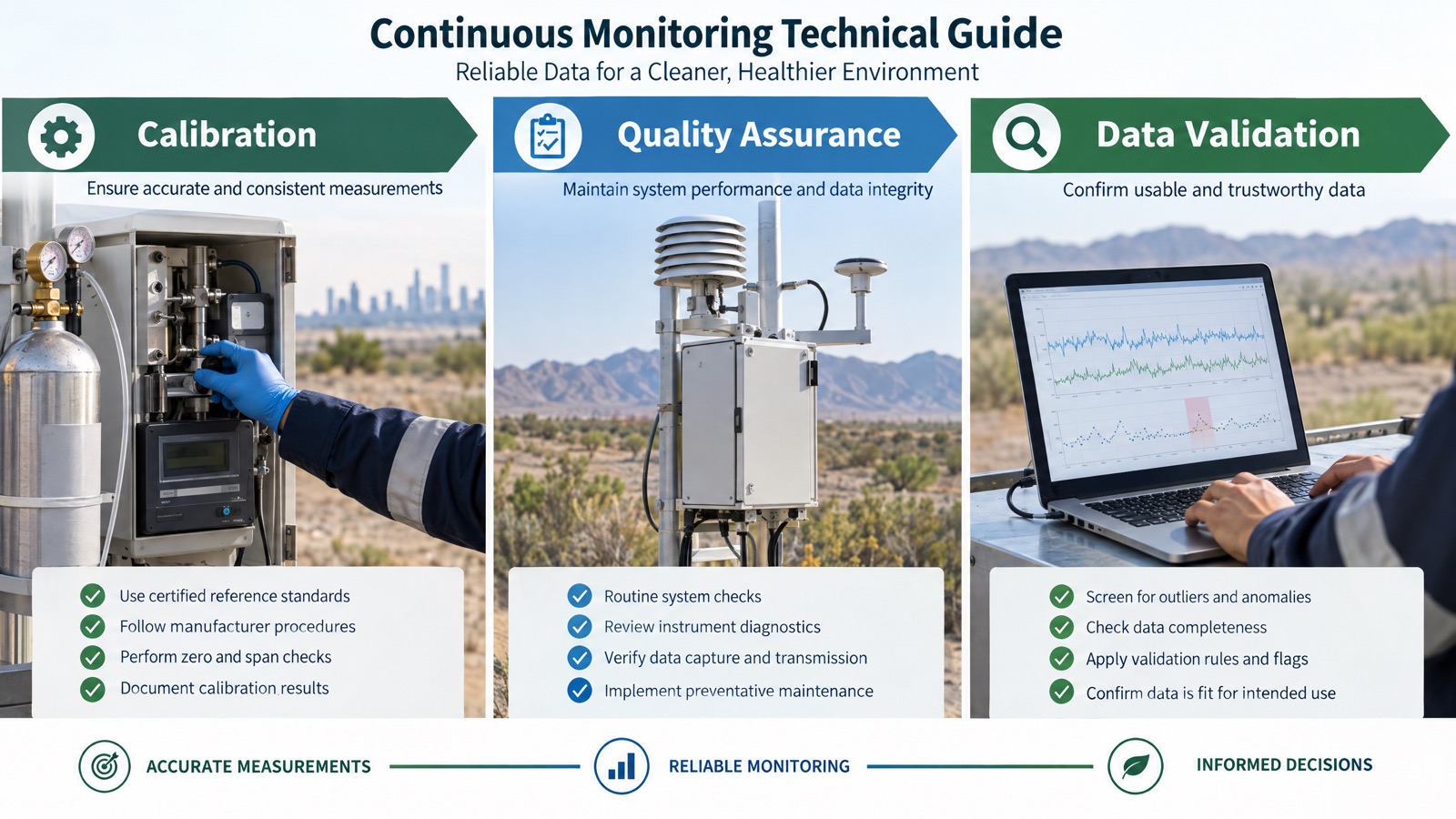
EnviroSaudi offers continuous monitor calibration services in Saudi Arabia, covering field QA/QC checks, maintenance planning and data validation for industrial, construction, infrastructure and urban air-monitoring networks. Continuous monitors create data every minute or hour, but continuity does not guarantee quality: the programme should show whether the monitor operated as intended and whether the record is fit for its stated purpose.
You receive a written proposal setting out the configuration, scope, lead time and price. Request a quotation
The plan must address heat, dust, humidity, access, power and communications. The right controls depend on the instrument, method and intended use; different monitor types should not inherit one procedure by default. Accredited laboratory calibration is a separate service with its own provider and scope (see the boundaries below), and equipment supply does not replace the method, permit or regulatory decision that applies to your project.
Calibration, QA, QC and validation are different tasks
Quality assurance, or QA, is the planned system: objectives, responsibilities, procedures, acceptance criteria, training and records. Quality control, or QC, is the set of operational checks used to show whether the system remains within those criteria. Depending on the instrument, QC may include inlet inspection, leak or flow checks, zero and span challenges, comparisons, time checks, fault review and preventive maintenance.
Calibration establishes the relationship between an instrument response and known reference values under defined conditions. A field zero/span check may test response or support an allowed adjustment, but it is not an accredited calibration. Data validation comes after collection: the reviewer uses records and rules to assign status, qualify questionable periods and decide whether values are suitable for the intended use.
These distinctions prevent two common errors: treating every service visit as a calibration certificate, and treating dashboard data as fully validated the moment it appears.
Continuous monitor calibration services: build a field QA/QC routine around the instrument
Begin with the manufacturer method, project specification and applicable authority requirements. Record each asset’s model, serial number, configuration, range, location and commissioning date. Assign owners for inspections, technical review and configuration changes.
A field checklist may cover:
- the inlet and sample path, filters and consumables
- flow, enclosure condition and power
- communications and clock synchronisation
- internal diagnostics and environmental readings
Zero/span or challenge checks, multipoint work and collocation are included only where technically appropriate. Acceptance limits, corrective action and the person authorised to adjust the instrument must be explicit.
Frequency is instrument-specific. Dust, drift, harsh exposure or critical use may justify closer checks. Calibration, maintenance and spare-parts planning is the delivery route; this article covers planning, while the manual and quality plan remain controlling.
Traceability and accredited-laboratory boundaries
Metrological traceability is a property of a measurement result. NIST describes it in terms of a documented, unbroken chain of calibrations to specified references, with each link contributing to measurement uncertainty. A label saying “traceable” is therefore not enough; the supporting reference, certificate, uncertainty and chain must be appropriate to the measurement.
Accredited calibration is a separate claim. ISO/IEC 17025 concerns the competence of testing and calibration laboratories and their ability to generate valid results. EnviroSaudi’s field inspection, zero/span checks, commissioning adjustments, maintenance and data QA/QC are field services, not ISO/IEC 17025-accredited laboratory calibration, unless a named provider’s current accreditation and exact scope cover the work. When accredited calibration is required, the project identifies the qualified laboratory, scope, interval, shipping or onsite method and certificate review.
Field QA/QC is still essential: it shows how an installed monitor behaved between formal calibrations. It complements laboratory or factory work; it does not replace it.
Validate data in controlled stages
Use visible status labels such as raw, provisional, reviewed and validated, with definitions agreed by the project. Automated rules can flag missing data, flat lines, impossible values, abrupt changes, diagnostic alarms, calibration periods and time drift. They accelerate review but should not silently delete measurements or make causal decisions.
Compare flags with maintenance logs, calibration results, weather, neighbouring stations and site activity. Every exclusion or correction needs a reason, approver and audit trail. Preserve original data and configurations. Record the version, source dataset, validity period and limitations of any correction model.
Completeness is not the same as validity. A month can contain nearly all expected records yet still be unsuitable because of drift; a shorter period may remain useful if exclusions are transparent. Reports state coverage, data status, exceptions and unresolved limitations rather than presenting one uninterrupted line as unquestioned fact. For multi-site projects, environmental data dashboards and alerts should preserve these states and permissions.
What a practical handover should contain
A monitoring handover includes:
- the asset register, approved procedures, schedules and acceptance criteria
- reference-material records and certificates where applicable
- configuration backup and user roles
- maintenance and exception logs
- validation rules, data-status definitions and escalation contacts
Training shows operators what they may inspect, what requires a technician and what must go to an accredited laboratory or manufacturer.
For a new ambient air-quality monitoring network, agree this quality framework before equipment is deployed. Retrofitting it after months of collection leaves gaps that cannot always be repaired. Services are available for projects across Saudi Arabia, including Dammam, Jubail and Riyadh.
Frequently asked questions
Who provides continuous monitor calibration services in Saudi Arabia?
EnviroSaudi provides continuous monitor field calibration checks, QA/QC planning and data-validation support for projects across Saudi Arabia. Accredited laboratory calibration, where required, is delivered by a named provider whose accreditation covers the work.
Is a field zero/span check the same as calibration, and what does traceability mean?
Not necessarily. A zero/span check may verify response or support an allowed adjustment, depending on the method, while accredited calibration is a distinct service with a defined provider, scope, reference chain and certificate. Traceability means a result can be related to a stated reference through a documented, unbroken calibration chain with each link contributing uncertainty; it does not prove a method is fit for every purpose.
How often should a continuous monitor calibration or check be scheduled?
Follow the applicable method, manufacturer instructions, project specification and observed performance. Exposure, drift risk, criticality and maintenance history inform the schedule; a universal interval is not appropriate for every instrument.
What is the difference between provisional and validated data, and should invalid data be deleted?
Provisional data has passed defined initial checks but may change after technical review; validated data has completed the project’s documented review and approval. Normally the original record is retained with its status, exclusion reason and reviewer, and software supports but does not replace controlled human review.
What affects the cost of continuous monitor calibration and QA/QC?
Cost depends on the number and type of monitors, check frequency, consumables and calibration gas, site access, accredited-laboratory needs, data-validation scope and reporting requirements.
How long does a calibration and QA/QC programme take to set up?
Timing depends on the instrument types, number of sites, access and documentation needed, and is confirmed in the quotation.
EnviroSaudi serves projects across Saudi Arabia, including Dammam, Al Khobar, Jubail, Riyadh, Jeddah, NEOM and Qiddiya.
Looking for continuous monitor calibration services in Saudi Arabia? Request a quotation and EnviroSaudi will set out the field QA/QC and validation scope for your network.