
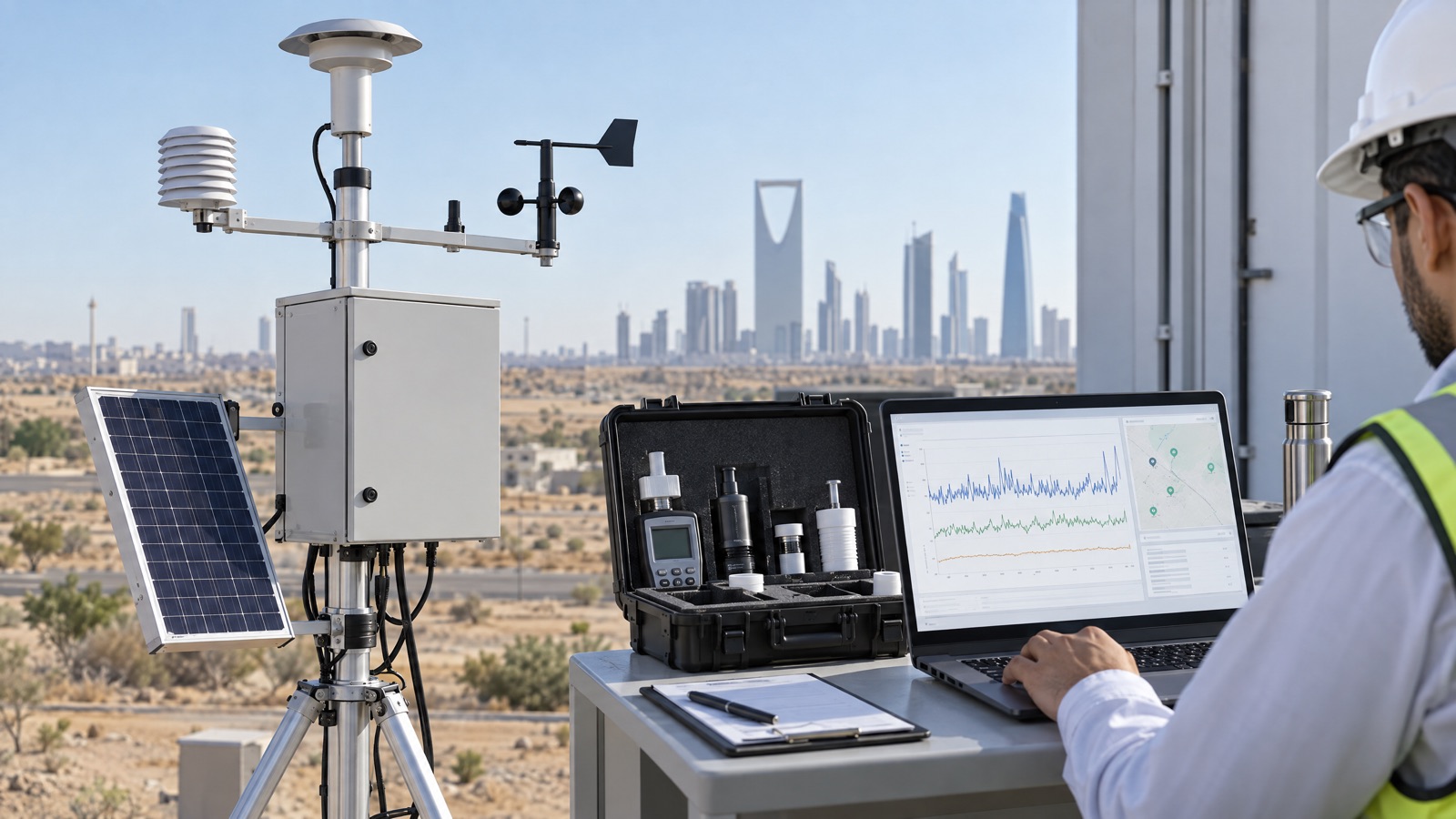
EnviroSaudi supplies air-quality monitoring equipment in Saudi Arabia, and a good air quality monitoring equipment specification for Saudi Arabia makes supplier proposals easier to compare and reduces costly assumptions after award. It should explain the measurement duty, performance expectations, site conditions, installation boundary, data outputs, acceptance evidence and lifecycle support. A list of pollutant names alone is not enough.
You receive a written proposal setting out the configuration, scope, lead time and price. Request a quotation
This guide addresses procurement of instruments and operational monitoring systems in Saudi Arabia. It is not a terms of reference for an EIA, regulatory baseline study, dispersion model or formal compliance programme. Those activities require a separately defined professional scope. EnviroSaudi turns an operational need into an equipment schedule through its monitoring needs assessment and equipment selection service.
1. State the purpose and intended use
Begin with the decision the measurements will support. Examples include construction-dust trending, industrial-boundary awareness, indoor ventilation monitoring, portable screening or continuous source measurement. State who will use the data, whether the need is operational or regulatory, the monitoring duration and what should happen when a threshold or fault occurs.
The intended use influences every later requirement. The US EPA Air Sensor Guidebook is designed to help users plan and collect measurements and highlights purchasing and project-design considerations. Its principles are useful for structuring questions, while the applicable Saudi project specification and authority requirements remain controlling.
2. Define parameters, ranges and performance for air quality monitoring equipment
For each measurement, specify the pollutant or environmental parameter, expected normal and upset range, required time resolution, averaging periods, units and data-quality objective. Ask suppliers to state detection range, resolution, accuracy or uncertainty where applicable, response time, cross-sensitivities, environmental limitations and evidence supporting the figures.
Avoid writing a brand feature as though it were a universal method requirement. Scentroid's CTmini product page lists PM1, PM2.5, PM4 and PM10 plus temperature, humidity and pressure. The CTair page describes configurable gas and particle sensor technologies. Those examples show why the specification should name the required parameters and performance, then require the bidder to identify the exact proposed configuration.
3. Describe the location and environmental envelope
Provide a location schedule or drawing. For every point, identify its purpose, mounting concept, safe access, nearby sources or obstructions, available space and any relocation requirement. State the expected ambient temperature, humidity, dust, solar exposure, coastal or corrosive conditions and hazardous-area classification where relevant.
Do not accept “outdoor rated” as the complete installation design. Ask for enclosure and inlet details, sun shielding, mounting loads, sample-line limitations, condensation management and maintenance clearances. Where a network has several stations, use monitoring network design and instrument siting to align station roles and communications.
4. Specify power, communications and data
State the available supply, voltage and backup expectations. If solar or battery operation is considered, define the required autonomy and the site's solar and load assumptions. Communications requirements should cover cellular bands or service ownership, LAN or Wi-Fi access, permitted protocols, cybersecurity constraints and behaviour during an outage.
The data section should define parameter names, units, timestamps, time zone, update interval, averaging, device-health fields, local buffering, retention, export formats, user roles, alarms and reports. Where data enters an existing dashboard or building system, require the device-specific point or register map and identify which party owns the receiving-system work. The environmental dashboards and interfaces solution explains this integration boundary.
5. Air quality monitoring equipment specification Saudi Arabia: make proposals comparable
Require a bill of materials that identifies manufacturer, model, sensor modules, ranges, accessories, mounting, enclosure, power items, communications hardware, software and licence assumptions. Ask bidders to mark deviations instead of hiding them in narrative. Datasheets should correspond to the offered revision, not merely the wider product family.
The documentation schedule can include configuration sheets, drawings, certificates supplied with the equipment, factory test evidence, manuals, spare-parts recommendations and warranty terms. Availability, delivery and warranty conditions are confirmed in each quotation. EnviroSaudi's equipment supply and configuration service prepares this package.
6. Define installation, commissioning and acceptance
Separate supplier, installer, customer and third-party responsibilities. Identify civil bases or brackets, power and network connections, lifting, access permits, hazardous-area work, SIM cards and firewall changes. Then specify commissioning checks: received-item inspection, installation verification, time and location, sensor configuration, communications, data path, alarms, user access and operator training.
Acceptance criteria should be observable and tied to the intended use. If calibration certificates are required, name the expected method and scope. ISO explains that ISO/IEC 17025 addresses the competence of testing and calibration laboratories; a manufacturer's quality-system statement is not automatically an accredited calibration certificate.
7. Include lifecycle requirements
Ask for routine inspections, field checks, calibration route, consumables, expected sensor replacement considerations, data review, support channels and recommended spares. Define who will perform each task and what records are required. Calibration, maintenance and spare-parts planning converts these items into an operating schedule.
Frequently asked questions
Who provides air quality monitoring equipment in Saudi Arabia?
EnviroSaudi supplies air quality monitoring equipment in Saudi Arabia and helps buyers turn an operational need into an equipment specification, with configuration, availability and lead time confirmed in each quotation.
How do I write a specification for air quality monitoring equipment?
Start with the intended use, because it determines parameters, range, performance, siting, data, acceptance and maintenance. A specification may name an approved or reference model when procurement rules allow, but it should still state the required performance, configuration and interfaces, since a family name alone does not define the offered sensors or options.
Which site and data requirements should buyers provide?
Provide temperature, humidity, dust, solar and coastal exposure, hazardous-area classification, mounting constraints, access, power and communications coverage. For data, include parameter names, units, timestamps, update and averaging intervals, status flags, local buffering, retention, exports, user roles, alarms, reports and verified interface requirements.
How should commissioning acceptance be written?
Use observable checks for equipment identity, installation, configuration, sensor response where applicable, time and location, communications, data display, alarms, recovery, user access and handover records.
What should a buyer send EnviroSaudi to start a specification review?
Send the monitoring objective, parameter list, expected ranges, locations, environmental conditions, power and communications, data users, interfaces, project programme and issued procurement requirements.
What affects the cost of air quality monitoring equipment?
Cost depends on the parameters and ranges required, the number of monitoring points, enclosure and power options, communications and software, installation and commissioning scope, and calibration and maintenance needs.
How long does it take to supply air quality monitoring equipment?
Timing depends on the configuration specified, the number of units, installation and commissioning scope, and documentation requirements. Lead time is confirmed in each quotation.
EnviroSaudi serves projects across Saudi Arabia, including Dammam, Al Khobar, Jubail, Riyadh, Jeddah, NEOM and Qiddiya.
Ready to compare proposals against your air quality monitoring equipment specification for Saudi Arabia? Request a quotation.