
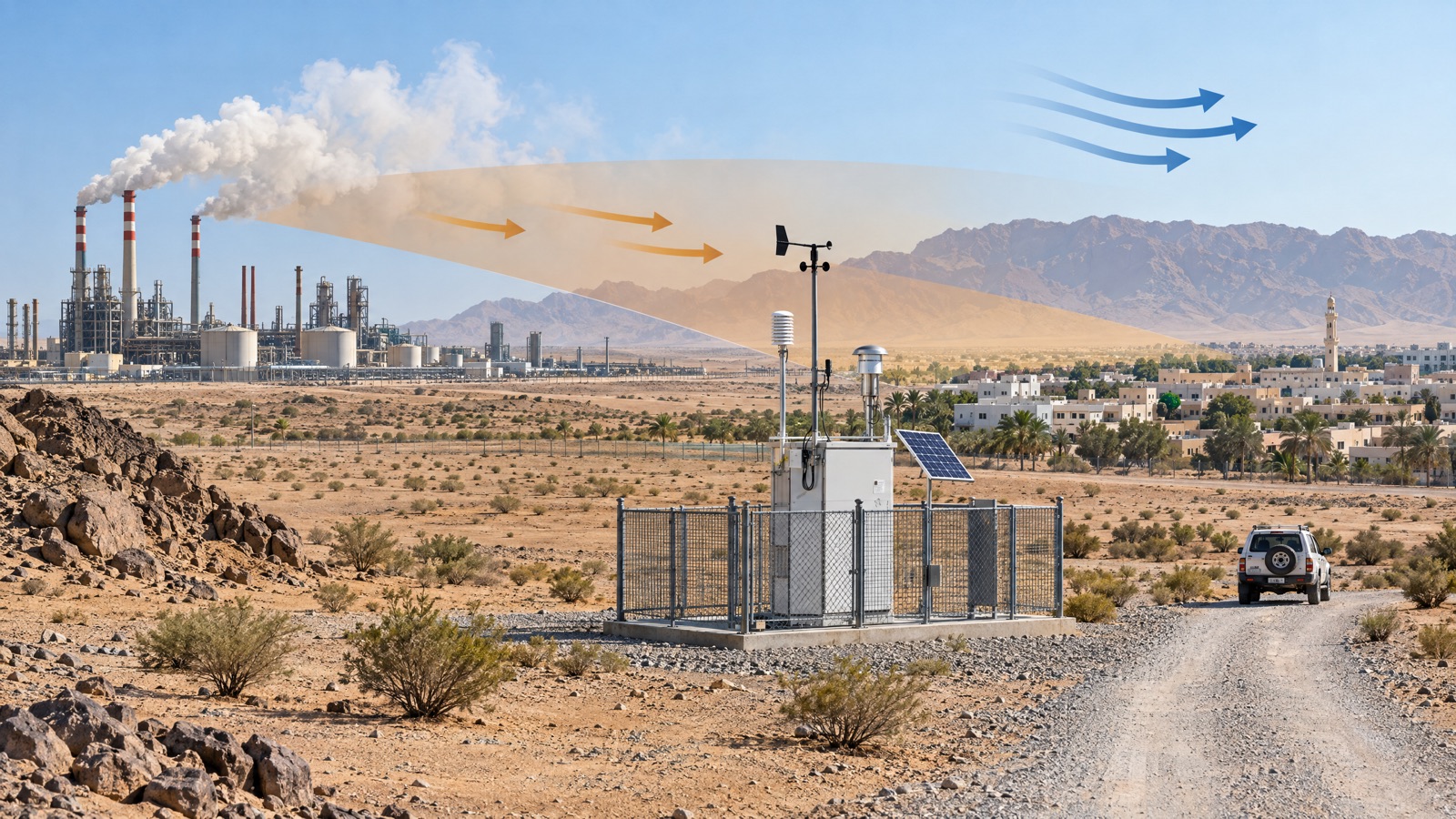
EnviroSaudi is an air monitoring station supplier in Saudi Arabia, and a station only measures the air reaching its inlet. A sophisticated analyser in the wrong position can miss the event, over-record a nearby disturbance or produce data that cannot answer the project question. Good siting therefore connects four things: the likely source, the people or assets that matter, the way air moves and the practical conditions needed to keep the station operating.
You receive a written proposal setting out the configuration, scope, lead time and price. Request a quotation
For Saudi industrial, construction and infrastructure projects, the siting plan should also anticipate extreme heat, dust loading, sun exposure, coastal corrosion, security, power and cellular coverage. The goal is not to find a universally perfect point. It is to document why each location represents a defined monitoring objective.
Begin with the decision, then map sources and receptors
State what the location must detect:
- A source-oriented point may capture changes near a stack area, tank farm, crusher, haul road or work front.
- A boundary point may support investigation of air leaving a site.
- A receptor-oriented point may represent a nearby community, school, workplace or sensitive ecological area.
- A background or context point can help distinguish broader conditions from site-related changes.
Draw these features on one map with property boundaries, elevations, buildings and access routes. Include intermittent sources and activities that move. A construction monitor located beside today’s excavation may become irrelevant after the work front shifts. Similarly, the nearest available fence may sit in a sheltered wake rather than represent air crossing the boundary.
Use wind as context, not automatic attribution
Prevailing seasonal winds are a useful starting point, but a single wind rose cannot describe every hour. Sea breezes, terrain, building wakes, strong daytime mixing and calm night-time conditions can change transport. Place meteorological measurements where wind is reasonably representative and away from avoidable obstructions or local exhausts.
One nominally downwind station may miss events when direction changes. Depending on the objective, a network may need an upwind or context point, one or more boundary points and receptor coverage. The meteorological and air-quality integration route explains the implementation role of time-aligned weather data.
Wind direction plus a concentration increase can strengthen an investigation, but it does not by itself prove which source caused the event. Multiple sources may lie in the same sector, and local flow can differ from the weather sensor reading. Operational logs, other stations and follow-up evidence remain important.
Protect inlet representativeness
The inlet should sample the intended air mass rather than a wall surface, generator exhaust, cooling discharge, parking area or dusty maintenance path unless that microenvironment is the explicit target. Nearby structures and vegetation can block flow or create turbulence. An inlet that is too close to ground disturbance may overstate local resuspension; one hidden behind a barrier may under-record crossing plumes.
There is no single separation distance that fits every objective and method. Formal programmes can prescribe probe height, clearance, spacing and spatial scale. For example, US 40 CFR Part 58 Appendix E sets detailed criteria for certain US ambient networks. Those provisions illustrate siting discipline and are not Saudi requirements. Check the applicable authority instruction, project method and manufacturer inlet constraints before installation. Equipment supply does not replace the method, permit or regulatory decision that applies to your project.
Air monitoring station supplier: design for safe, continuous operation
A theoretically attractive location is not workable if technicians cannot reach it safely or if power and communications fail repeatedly. Check land permission, traffic interaction, hazardous-area classification, fall and lifting risks, lighting, drainage, flood exposure, cable protection and clearance for calibration or filter changes. Avoid positioning that invites vandalism or vehicle impact.
Confirm mains or solar capacity for the full system, including pumps, enclosure cooling or heating and communications. Survey cellular signal at the proposed equipment height rather than relying on a phone reading elsewhere. Plan local data storage for outages, and make enough space for zero/span equipment, inlet inspection and safe door opening.
Saudi heat and solar load can make the temperature inside an enclosure very different from reported ambient temperature. Dust can block vents or load filters, while coastal salt can accelerate corrosion. Equipment ratings, shelter design and service intervals should address the actual site, not just a city-level climate average.
Record, review and control relocation
Give every station a stable identifier and retain coordinates, elevation, inlet height, orientation, photographs, nearby obstructions, power arrangement, sensor configuration and commissioning date. Record changes to buildings, activities and vegetation. This metadata makes later comparisons and investigations defensible.
When a station must move, preserve the reason, old and new coordinates, exact transition time and any overlap period. Do not join the two locations into one uninterrupted trend without flagging the change. Periodic siting reviews are particularly important on construction sites and expanding industrial facilities.
The commercial network design and instrument siting page covers project-specific surveys and layouts. Related implementation routes include industrial fenceline air monitoring and ambient air-quality monitoring networks. This guide helps a buyer prepare inputs; it does not certify a location or replace formal modelling. Station supply is available for projects across Saudi Arabia, including Dammam, Jubail and Riyadh.
Frequently asked questions
Who is the air monitoring station supplier in Saudi Arabia?
EnviroSaudi supplies air monitoring stations for projects across Saudi Arabia and prepares the station configuration, siting inputs and quotation for each site.
Is one downwind station enough, and does every network need an upwind station?
Not always. Wind direction changes and local structures can redirect flow, so the required number and arrangement depend on the objective, source geometry, receptors and weather. A well-chosen background or context location can help interpret regional conditions, if it truly represents the comparison air mass.
How do I site an air monitoring station inlet, and how far from walls or exhausts?
Use the applicable method and project criteria. Review inlet height, airflow, obstruction clearance and local discharges; no universal distance is suitable for every monitoring purpose.
When should a station be relocated?
Consider relocation when sources or work fronts move, access becomes unsafe, structures change airflow or the point no longer represents its objective. Document and flag every move.
What affects the cost of an air monitoring station?
Cost depends on the instrument class and parameters, number of stations, enclosure, power and communications, site survey needs, access and safety provisions, and maintenance arrangements.
How long does supply take, and what information is needed before a site survey?
Lead time depends on the station configuration and site readiness, and is confirmed in the quotation. Provide the monitoring objective, source and receptor map, boundary and ownership data, terrain, seasonal wind information, planned site changes, method constraints, utilities, communications, safety rules and access windows.
EnviroSaudi serves projects across Saudi Arabia, including Dammam, Al Khobar, Jubail, Riyadh, Jeddah, NEOM and Qiddiya.
Looking for an air monitoring station supplier in Saudi Arabia? Request a quotation and EnviroSaudi will prepare the station scope and siting inputs for your project.