
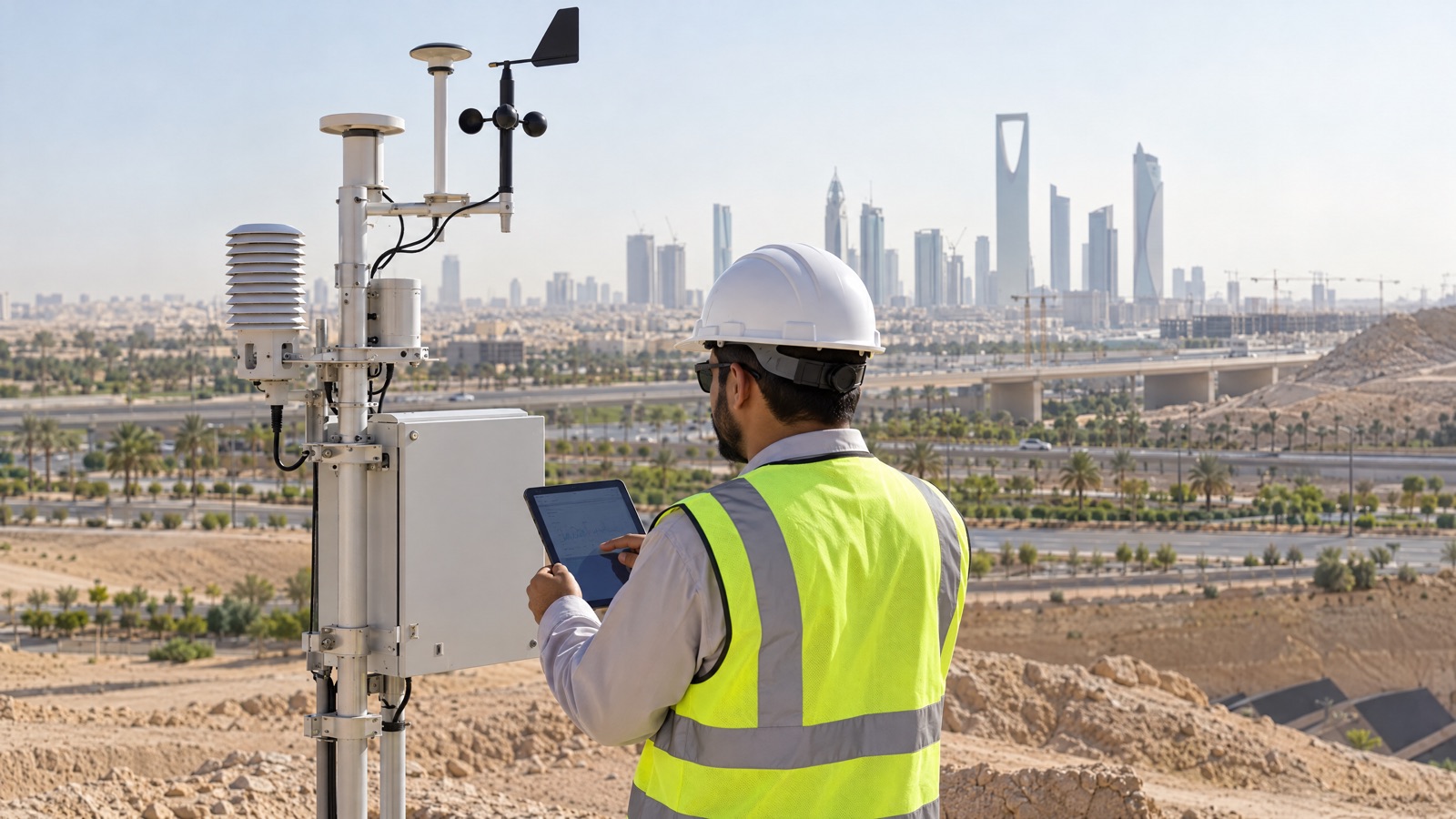
This guide explains how to plan air monitoring for infrastructure projects in Saudi Arabia, covering particulate, selected gas and meteorological monitoring equipment, operational dashboards and deployment support for large construction and infrastructure programmes. These programmes need more than isolated dust monitors. Work fronts move, contractors change, temporary power is interrupted and stations may be relocated several times. A useful programme therefore combines appropriate equipment with a common data structure, repeatable commissioning, maintenance planning and clear responsibility across packages.
You receive a written proposal setting out the configuration, scope, lead time and price. Request a quotation
EnviroSaudi works with developers, programme managers, contractors and supervision teams on live-monitoring systems. Equipment supply does not replace a construction environmental management plan, EIA, compliance determination or regulatory approval, which are separate professional scopes.
Set a programme framework before package procurement
Begin by identifying why measurements are needed and which decisions they will support. A programme may want to observe boundary conditions, compare work zones, track dust during earthworks, maintain records across contractors or provide timely alerts to site teams. These uses influence the parameters, station density, siting, measurement method, update rate and data-quality controls.
A programme-level schedule should define common station types, naming rules, data fields, timestamps, location records, alarm ownership, maintenance records and handover expectations. Individual packages can then add local detail without creating incompatible systems. The construction-site air-monitoring solution provides an equipment route, while monitoring network design and instrument siting turns programme objectives into station roles.
Central procurement can also define approved configuration variants and required accessories while allowing package quantities and locations to change. This reduces accidental differences in units, firmware, communications and spare parts without assuming that one station type fits every activity.
Match station types to changing construction activities
Earthworks, demolition, crushing, concrete production, stockpiles and unpaved vehicle routes create different dust patterns. A compact particulate node may suit distributed trending, while a larger configurable station may be justified where gases or additional parameters are required. Portable instruments can support screening, but they should not be treated as permanent stations or personal-safety devices without evidence for that use.
Scentroid's CTmini page lists PM1, PM2.5, PM4 and PM10, along with temperature, humidity and pressure, onboard storage and several mounting and communications options. Those features suit a candidate construction configuration, but the project must still confirm performance, enclosure, range, power and communications. The US EPA Air Sensor Toolbox emphasises performance evaluation, collocation and interpretation, which helps explain why compact sensor data should not automatically be presented as equivalent to regulatory reference measurements.
Add weather data with a defined purpose
Wind speed and direction can help teams compare changing particulate readings with activities and locations. Scentroid's Compact Weather Station lists wind, temperature, humidity, pressure and precipitation measurements. A proposal should confirm siting, mounting height, obstructions, orientation, data intervals and how the weather stream will be aligned with air measurements.
Weather context is not automatic proof of source attribution. Formal dispersion modelling and specialist attribution studies require a separate scope. EnviroSaudi's meteorological and air-quality integration solution focuses on hardware, compatible data paths and operational display.
Design for relocation without losing traceability
Station moves should be controlled events. Before relocation, record station identity, coordinates, package, purpose, configuration, condition and final timestamp. After relocation, record the new coordinates and purpose, then verify mounting, inlet, power, time, communications, sensor status, dashboard location and data flow. A station history helps users distinguish a real trend from a change in position.
The same logic applies when equipment transfers between contractors. The handover should state who owns the instrument, data, SIM service, dashboard account, inspection schedule, alerts and spare parts. Installation and commissioning coordination establishes repeatable checks, while calibration, maintenance and spare-parts planning defines lifecycle tasks.
Create one operational data language
Multi-package programmes benefit from consistent device names, parameters, units, time zones, status flags, averaging and alarm categories. Dashboards should distinguish concentration thresholds from instrument faults, power loss, communications loss and overdue maintenance. User roles can limit each contractor to relevant assets while programme teams retain the wider view.
Thresholds should come from the approved project requirements, not be invented by the monitor supplier. Saudi Arabia's National Center for Environmental Compliance describes national oversight of environmental-media monitoring and data, but each project must confirm which current requirements and approvals apply to its locations and activities.
How to plan air monitoring for infrastructure projects: site conditions and logistics
Heat, dust, solar loading, coastal humidity, long distances, restricted access and variable cellular coverage affect monitoring-system design. The scope should address mounting, shading, inlet protection, power autonomy, local buffering, inspection frequency, secure access and the route for replacing consumables.
EnviroSaudi is available for programmes across Saudi Arabia, including Riyadh, Jeddah, Dammam, NEOM and Qiddiya, where access and delivery arrangements are agreed.
Frequently asked questions
Who provides construction site air monitoring in Saudi Arabia?
EnviroSaudi supplies construction site air monitoring in Saudi Arabia. A scope can combine particulate and selected gas monitors, weather instruments, power and communications, dashboard configuration, repeatable commissioning, relocation records, operator training and lifecycle planning.
How should monitoring be coordinated across several contractors?
Set common station types, naming, parameters, units, timestamps, status flags, dashboard roles, alarm ownership, maintenance records and handover rules at programme level, then add package-specific locations.
Can compact particulate sensors replace regulatory reference monitors?
Not automatically. Their fitness depends on the intended use, required method, performance evidence, collocation, quality controls and the project's acceptance criteria.
What should happen when a station is relocated?
Record its previous location and purpose, inspect its condition, document the new coordinates and role, then verify mounting, power, time, communications, sensor status and data flow.
How do I plan air monitoring for infrastructure projects across a programme?
Provide layouts, work packages, activity programme, sensitive locations, parameters, methods or specifications, power, communications, data users, alarm workflow, relocation assumptions and access constraints, and EnviroSaudi prepares a programme-level proposal.
What affects the cost of construction site air monitoring?
Cost depends on the number and type of stations, parameters and weather instruments, power and communications, dashboard configuration, relocation needs and lifecycle support.
How long does it take to deploy construction site air monitoring?
Timing depends on the station configuration, number of packages and locations, access and delivery arrangements, and commissioning scope. Configuration, availability and lead time are confirmed in each quotation.
EnviroSaudi serves projects across Saudi Arabia, including Dammam, Al Khobar, Jubail, Riyadh, Jeddah, NEOM and Qiddiya.
Working out how to plan air monitoring for infrastructure projects? Request a quotation for your programme.